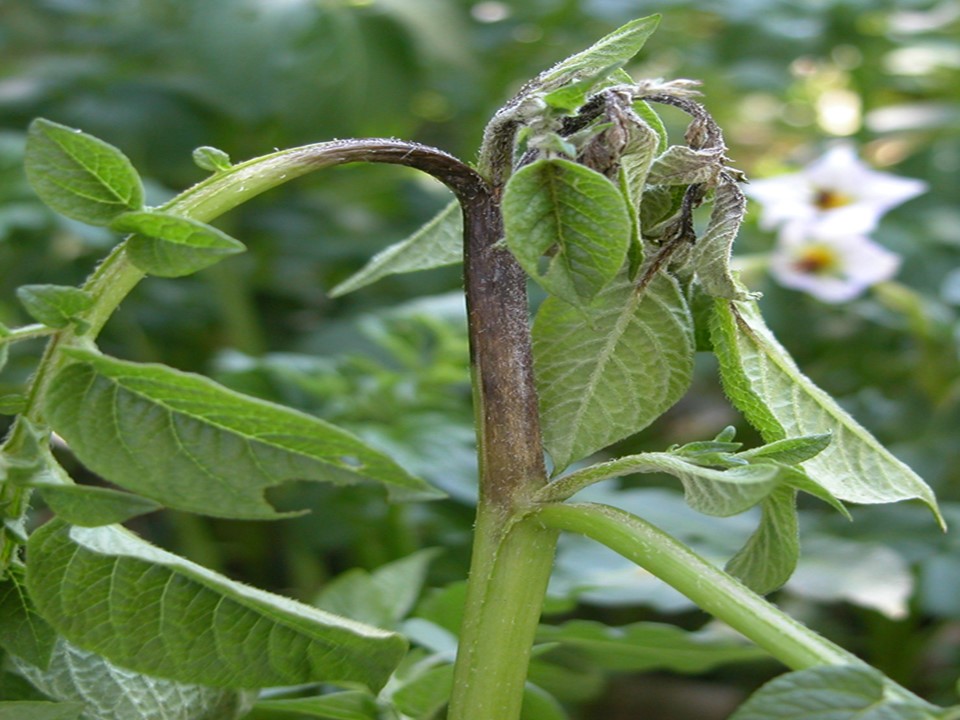
Research that brought two U.K. teams together has allowed them to connect the dots on late blight – which could lead to a better understanding of how to TKTK the disease.
The new research, published in late 2025 in Nature Communications, describes a family of enzymes produced by a the microorganism known as Phytophthora infests – but better known to potato and tomato farmers as late blight. The recurrent disease threat comes from a pathogen which employs special enzymes, known as AA7 oxidases, to disable the plants’ early warning systems, which weakens their defences before they have time to respond.
It’s through that weakened defence system that late blight thrives.
Late blight is, according to Steve Whisson, molecular potato pathologists with Hutton Institute, probably the biggest disease threat to potatoes in the U.K., and, he assumes, most potato-growing markets. “Farm gate sales are around about 1.4 billion pounds in 2024,” he explained. “The impact of potato late blight is about 50 million pounds.” That impact, he says, is not only through direct crop losses but also in controlled costs.
The origins of the research go back a long way, says Whisson, but it’s simplest to start in 2018, when Whisson’s colleagues from the University of York with data on the then-new-to-them AA7 oxidases. “They thought they’d made quite an interesting discovery, [which] we’d never heard of before,” explains Whisson. While Whisson’s team thought they hadn’t heard of these enzymes before, the research presented them allowed them to connect the dots.
“We realized, ‘oh hey, we’ve seen this before, and we didn’t know what it was,’” Whisson explains. “It was the joining up of the two research programs that has really driven this.”
Growers already know that plants react to injury not unlike humans – but now the joint team knows better about how this pathogen takes advantage of that tendency. “If I were to poke myself in the hand in the needle, that would set up a whole chain of events that ends in me going ‘ow, that hurts,’” Whisson explains. “Neurotransmitters get sent; there are signals that happen in your body which means that your immune system reacts and send signals to that part of your body.”
Microbes that cause disease break down disease like cellulose and pectin, which make up the cell wall – they have to do that to get into plants. “Plants have evolved over millions of years to recognize those signs of attack, of injury. Those releases of those little bits of pectin can be detected by the plant as an injury profile. It can react by activating defence responses that tells the plant, ‘I’m under attack, I must react to repeal whatever is attacking me.’ They do that by signalling the cells that are under attack.”
What they detect are small fragments of the cell wall – little pieces of pectin in the case of the U.K. study – and that activates defences against the pathogen. But what this late blight pathogen has done is employ those AA7 oxidases enzymes to slightly modify those pieces of pectin to no longer be recognized. Those modified, small pieces of pectin bind to the potato’s receptors that would normally detect them, and they bond a little more strongly than normal, says Whisson, so they become dominant and the receptors can no longer detect what is going on.
So what is next? The Hutton and York teams have looked at identifying the nature of how the late blight pathogen works to weaken potatoes’ defences, but that’s not the same as control or treatment.
In the U.K. and Europe, where there are significant restrictions on the application of synthetic chemicals and a strong drive to reduce synthetic pesticides, coupled with new strains of late blight that are resistant to some of the more recently developed chemicals, Whisson says there is a “storm brewing” for late blight.
But having this information gives them a target. Specifically designing a specific chemical to block the action of the enzymes that block the pectin fragments would probably take a decade of research and develop – far too expensive and time-consuming, says Whisson. Late blight could do too much damage during that time. However, he says RNA-based strategies, similar to the RNA vaccines developed during the COVID-19 pandemic, could be an option. He points to the example of spray-induced gene silencing, an RNA-based strategy, exploits both the naturally occurring systems within the pathogen and the plant.
“You can spray on an RNA molecule which matches what is already present in the late blight pathogen, and it will use that to degrade its own gene sequences,” he explains. “We know it’s essential for its disease-causing ability. If we take out the activity of that gene, we can start to control the disease.”
There are groups around the world who are looking at this RNA strategy – not necessarily with the genes discovered with this most recent research, but “our discovery would add to the list of potential candidates,” says Whisson. There are various groups around the world looking at applications of this technology for disease control. “RNA is a naturally occurring molecule, and it degrades really easily – so you don’t have residues left in crops.”
This technology is at the “proof of concept” stage currently, but scale is currently unproven, says Whisson, so it’s a long road, but every step counts.