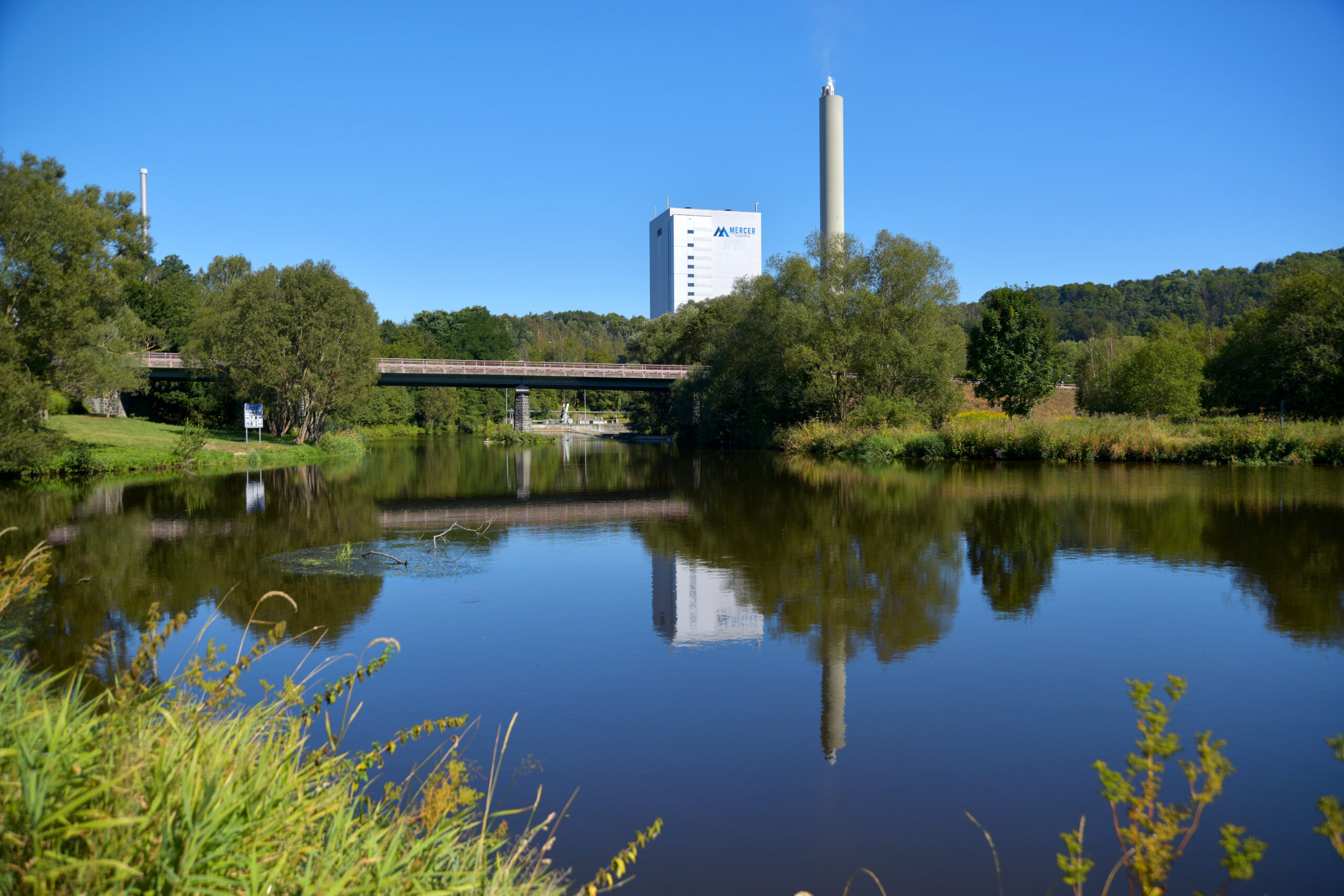
Mercer International is a major player in the global forest products sector. Between its operations in the U.S., Canada, and Germany, the company has a consolidated annual production capacity of 2.1 million tonnes of pulp, 960 million board feet of lumber, and 230,000 tonnes of biofuels.
The company has been hard at work finding ways to reduce its overall emissions. It is targeting a 50-per-cent reduction in Scope 1 emission intensity and a 35-per-cent reduction in Scope 2 emissions by 2030. To do this, Mercer International is focused on reducing emissions and exploring opportunities to sequester carbon throughout its value chains. The majority of the company’s overall energy production (86 per cent) comes from renewable biomass sources such as black liquor and wood waste from its various forest products operations.
All four of its pulp mills run on self-generated green energy. In 2022, the company’s mills had a combined generation capacity of approximately 400 MW of electricity with 60 per cent of the electricity used to power mill operations and the surplus sold to local grids, which generated approximately $100 million in revenue for Mercer International while creating renewable energy for regional utilities.
Juan Carlos Bueno, president and CEO of Mercer International, says meeting the company’s Scope 1 intensity targets is the company’s current focus.
“When you think overall about our greenhouse gas emissions today, it’s around 486,000 tonnes of CO2 on Scope 1,” Bueno says.
Mercer International’s biggest project coming online in the near future to help meet their Scope 1 targets is the conversion of a lime kiln at its Stendal Mill, the company’s largest pulp mill in Germany. Currently fuelled by natural gas, the lime kiln will be converted to a bio-based fuelled lime kiln.
“That would be a significant contributor towards that goal of reducing 50 per cent of Scope 1 GHG emission intensity,” Bueno says.
Converting this lime kiln is no small feat. It requires an investment of about 35 million EUR, which in today’s conversion is nearly $55 million (50 per cent incentivized by government grants).
“We’re very eager to get that started by the end of this year. That would mean that in a year-and-a-half or two years that would become a reality, and Stendal would become almost a carbon neutral mill,” Bueno says.
He adds that while meeting emissions targets is a main goal of this project, their customers also demand these targets be met.
“The large tissue companies, some of the large paper companies, those that have a business much more global and sophisticated, they see that demand from their customers themselves, and they themselves have huge drivers around these things,” Bueno says. “They also have the same goals of reducing greenhouse gas emissions on Scope 1 and Scope 3 – we are part of their Scope 3 emissions – meaning our emissions are counted in their supply chain footprint – so they’re putting pressure on us to make sure that we contribute positively to their goals. We’re in a chain where everybody’s looking at the same picture, and that that helps, because then we’re all we’re all heading in the right direction. We’re all supporting each other as we run through this.”
While no company would want the negative press and public outcry from not meeting their emissions targets, there is more at stake if the company were to fail.
“Most likely we would lose some of those customers. It has been made explicitly clear that this is a condition of doing business in the future. Therefore, you need to show that you care. You need to show that you’re willing to put your wallet where your mouth is and that you are really going to contribute positively to this outcome,” Bueno says.
The Stendal Mill conversion project is of particular importance because it is Mercer International’s largest pulp mill with the largest lime kiln within the company’s pulp mill assets. The mill produces 740,000 tonnes of softwood pulp (mostly spruce with a diet of spruce, pine and fir).
The company’s other pulp mill in Germany, Mercer Rosenthal, produces 363,000 tonnes of softwood pulp, and could also undergo a similar conversion project sometime in the future.
Given the customer profile for Mercer International’s European pulp mills, these types of projects are a priority for them versus the company’s Canadian mills. This is because most of the customers for its Canadian mills operate within the Asian markets, where the same pressures related to meeting emissions targets are a much lower priority. However, Mercer International is still focused on reducing emissions at its Canadian pulp mill operations.
“We do have another project, a carbon sequestration project, and that would be for the Alberta pulp mill that we have in Canada.”
The Mercer Peace River pulp mill in Peace River, Alta. is a swing mill that produces approximately 475,000 tonnes of hardwood and softwood pulp. The company is in the process of potentially investing heavily into a new technology for sequestering the CO2 from the flue gases of the pulp mill.
“We’re working with a company in Canada that developed a technology for capturing that CO2. The reason why we’re doing it there is because the mill is located in Alberta, where you have geological formations that are suitable for sequestering CO2,” Bueno explains. “You don’t have to take it long distances. You’re right where you need to be, and that makes the project financially viable.”
The process for removing the CO2 from Mercer Peace River’s pulp mill operations would be a non-intrusive, mechanical process using a proprietary technology developed by Svante, a carbon capture and removal solutions provider based in Burnaby, B.C.
“We’re working with them, going through all the phases that are needed, before we are ready for an investment decision,” Bueno says. “It’s making sure that the technology works, that is the big hurdle. They tested it. They have demos, they have pilot plants, so they’ve done their homework. This would be the first large-scale pulp mill investment. So, we would be the first of a kind for their technology, and that’s why it takes a bit longer to make sure that we have it all squared through.”
The investment decision will take approximately two years to complete. At an estimated price tag of more than $500 million, there are several hurdles still to overcome. One of the biggest challenges is ensuring that the Province of Alberta and Government of Canada are supportive through grants in offsetting the technology risk. In total, these grants could account for upwards of 75 per cent of the total project costs.
“Alberta is incredibly supportive in both the policy framework and offsetting the technology risks, and that makes a difference,” Bueno says.
If everything aligns for the investment side of the project, the construction will take another two years to complete, meaning the project would come online and begin sequestering carbon from Mercer Peace River sometime in 2029.
Mercer International offered an explanation of Svante’s carbon capture technology works:
Svante’s carbon capture system uses proprietary solid sorbent filters designed to selectively capture carbon dioxide (CO₂) from industrial flue gas. These filters are coated with metal-organic frameworks (MOFs)—engineered nanomaterials that bind CO₂ molecules while allowing other gases to pass through. Once saturated, the filters are heated to release the CO₂, which can then be compressed for transport and storage. The system operates in a continuous adsorption–desorption cycle and is well-suited for pulp mills like Mercer Peace River, where biogenic CO₂ is emitted at scale.
Svante’s technology is compact, modular, and built to handle the challenging particulate environment of industrial flue gas. It also takes advantage of low-grade waste heat from mill operations, reducing energy requirements and increasing cost-effectiveness. With no toxic emissions or liquid solvents, and recyclable materials, the system offers a cleaner, more adaptable alternative to traditional carbon capture methods.
Lignin production
Another interesting project underway is at the Mercer Rosenthal pulp mill in Germany.
The company has invested 10 million EUR into a pilot project where it is producing one ton of lignin per day from black liquor being produced at the pulp mill. Instead of burning all of the black liquor to produce electricity, Mercer International would rather produce lignin as a potential substitute for fossil-based chemicals in various applications. The plan is to create a commercial lignin production facility within three years.
“We aim to have a commercial site out of Rosenthal that would be a 40,000-ton lignin plant. That means our output of energy would be reduced, because then we would not be burning as much, and we will be extracting this lignin to be able to sell it to the market into products that replace fossil-based fuels and sequester carbon for many years, instead of releasing it when we burn it,” Bueno explains. “We like it because it contributes to our circular economy story in a very significant way. It’s more profitable than energy, and it takes us into a different avenue. It allows the mills to participate in other things and not just be dependent on pulp, and only pulp. Breaking into that paradigm, for us, is very important, making these assets true bio-refineries, and being able to do a whole lot more than just pulp.”
While producing byproducts such as lignin has a strong business case, Bueno says it is also the responsible thing to do as a producer, as it provides low carbon solutions throughout the supply chain.
“That’s why we do it. We’re all trying to make our businesses more and more sustainable over time,” he says.