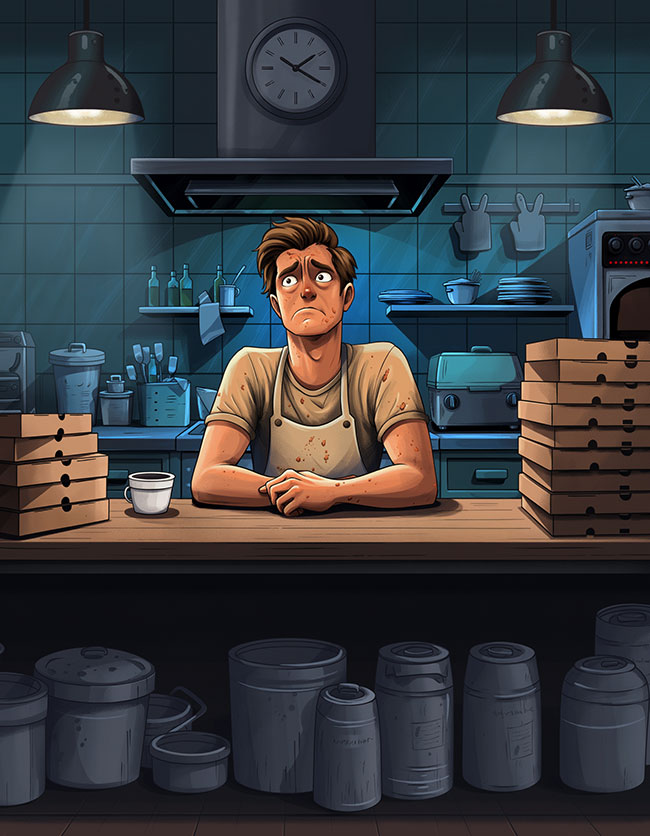
Owning a pizzeria is extremely challenging. Managing employees, implementing marketing campaigns, performing myriad administrative tasks and maintaining a high level of customer service all compete for one’s attention. With razor-thin margins hovering around three to five per cent, rising food costs and high employee turnover, profitability often feels far from certain. Stress is an inherent part of a pizzeria owner’s life.
Employees have it only slightly better. The restaurant industry is known for its brisk pace, low wages and demanding customers.
A study published by the Canadian National Institute of Health found that restaurant workers’ levels of the stress hormone cortisol are three times higher during normal work than those of the average adult. In other words, the restaurant industry is extremely stressful.
Too much stress can lead to burnout. Burnout decreases job performance, increases workplace injuries and leads workers to quit the industry entirely, leading to a sky-high restaurant industry turnover rate.
How does one identify burnout? Like any mental health concern, it can take many troubling forms. Some common signs include:
- Lack of passion: Most people find some enjoyment in their work. People who become unmotivated and unable to find pleasure in tasks they once enjoyed are likely stressed.
- Poor attendance: This is often a direct result of the of the above – normally punctual staff who are now late or fail to show up.
- Irritability: People who are normally even keeled who suddenly become short tempered may be burned out.
- Insomnia: If a person isn’t sleeping and is constantly exhausted it could be a sign of mental fatigue.
There are of course many other signs to watch for. The important thing is to take note of changes of behaviour in yourself or your staff.
Causes
What are the causes for burnout in the industry? They are many, and what stresses ownership is often very different than what stresses staff.
Financials, as one might expect, are a primary source of anxiety among owners, according to Jeff Dover, principal of fsSTRATEGY Inc.
“It is a tough business,” Dover says of running a pizzeria. “The average quick-service restaurant in Ontario generates a pre-tax profit of 2.8 per cent of sales (Restaurants Canada 2025 Operations Report). Financial pressures are challenging.”
“If the sales are not enough to pay the occupancy costs (that is, a bad lease), the restaurant will not be profitable. As a rule of thumb, occupancy costs (including utilities) cannot exceed 12 per cent of sales for the restaurant to be profitable,” he continues. “Labour costs, along with cost sales, are, by far, the greatest expenses in a restaurant. These must be controlled. As a rule of thumb, combined cost of sales and labour costs should not exceed 65 per cent of revenues (and we recommend 60 per cent). If greater, you won’t be profitable.”
Burnout causes staff to leave the industry, and concerns over stressful work environments prevent people from entering the field. This unfortunate cycle causes additional anxiety for owners and managers.
“Finding and retaining people, especially cooks, is a challenge that can cause stress,” Dover explains. “And, in the restaurant industry, you are working when most people are off and relaxing, which impacts quality of life and can result in people burning out.”
Employee retention
High staff turnover is both a cause and a symptom of workplace stress: people leave because of burnout and remaining staff may become overtaxed filling vacated roles. It therefore truly behooves management to find ways to retain good employees.
“‘But I don’t have the finances to offer large raises!’ It’s a common refrain among owners-operators whenever the topic of retention comes up. There are other things you can do – perhaps more important things – to ensure staff remain.
“The primary thing I find that restaurants do poorly that impacts turnover is not being flexible with scheduling,” offers Dover. “Staff are pressured to work (and not request time off) during busy periods, such as Friday evenings and weekends. Most people want to work when it is busy, but when they have a personal event to attend and can’t get the time off, they start to disengage. Flexibility is key.”
To ensure staff and owners alike can step away from work, many successful restaurants schedule downtime for their entire team by closing for a day or a week.
Downtime during a workday is equally important. The fast-paced restaurant culture often comes at the cost of taking breaks. It shouldn’t. Breaks are important for reducing stress and mental fatigue, but equally they play an essential role in maintaining productivity, fostering a healthy culture and boosting job satisfaction. Breaks should be hard-scheduled – cast in stone and unable to be altered. The benefits of hard-scheduled breaks are manyfold. From the management perspective, it ensures there is no gap in coverage, thereby ensuring customer service and profitability don’t suffer. And, circling back to employee retention, people tend to leave workplaces where breaks are not prioritized.
Another avenue for creating a positive workplace culture that encourages retention is to meaningfully engage employees. An overwhelming majority (74 per cent) of employees say that they are more invested in their workplace when they feel heard. Encourage your team to raise concerns about workplace stress and to offer ideas for making the restaurant less pressure-filled and more efficient. Not only does this make for a happier workforce but you may be surprised by the ideas they bring forth for streamlining your operational processes.
Streamlining operations
Streamlining a restaurant – making it run more efficiently and more profitably – is key to reducing the chance of burnout.
What are some ways of achieving that? Jeff Dover has some thoughts.
“Many restaurants would benefit from implementing food cost controls, which most managers know how to do but nonetheless often gets ignored when dealing with the daily challenges of running a restaurant,” he says. “Implementing cost controls in purchasing, receiving, storage, production and service will reduce costs and increase profits.”
“From a labour perspective, the focus should not be minimizing costs but making sure the right number of staff are scheduled to operate the restaurant smoothly,” Dover continues. “This comes down to forecasting hourly sales. At what level of sales do you add a second pizza cook? When do you add a second driver? What time should people start? These are important decisions to make.”
Reducing food preparation tasks can help to reduce kitchen staff workload. Assess recipes to see if there are ways to pre-prep ingredients and alter offerings with an eye toward dishes that are easy to prepare.
Technology can be used to streamline operations. This begins with reviewing your point-of-sale systems to ensure you are leveraging all the available tools, which might include scheduling, email marketing and online order organizing.
Maximizing profits
A profitable restaurant is generally a happy one. Here are practical strategies that have helped pizzerias transform their bottom lines.
One easy strategy for increasing your profit margin is to focus on reducing food waste. Use restaurant inventory software to track every ingredient and restaurant supply used and then review for wastage. Inventory software can also keep an eye on expiration dates. You can also cut down on food waste by redesigning your menu with fewer options, focusing on those that sell the most, offer the highest profit margin and are the easiest to prepare.
Upping your digital presence will help maximize profits because customers visit restaurant websites to get business hours, digital menus and contact information. In addition to a website, restaurants should create a social media presence to engage customers and promote themselves. Best of all, social media is virtually free.
“For pizza restaurants, marketing in the area is important,” Dover says. “However, you must make sure you are tracking the success of programs. If you mail coupons, track the sales against the cost. Same for social media coupons. People are pulling back on restaurant spending, given the current cost-of-living crisis. Loyalty programs work; you should have one.”
Taking measures to reduce workplace stress is one of the most important things you can do to optimizing yourself and your staff, maximize value, delighting guests, and, ultimately, ensure your pizzeria’s financial health and long-term viability.
Andrew Hind is a freelance writer from Bradford, Ont., specializing in food, history and travel. He is the author of 25 books and the proud father of one.