Pizza styles often begin as regional favourites then show up in unexpected places after a pizza chef discovers them while travelling and brings them home.
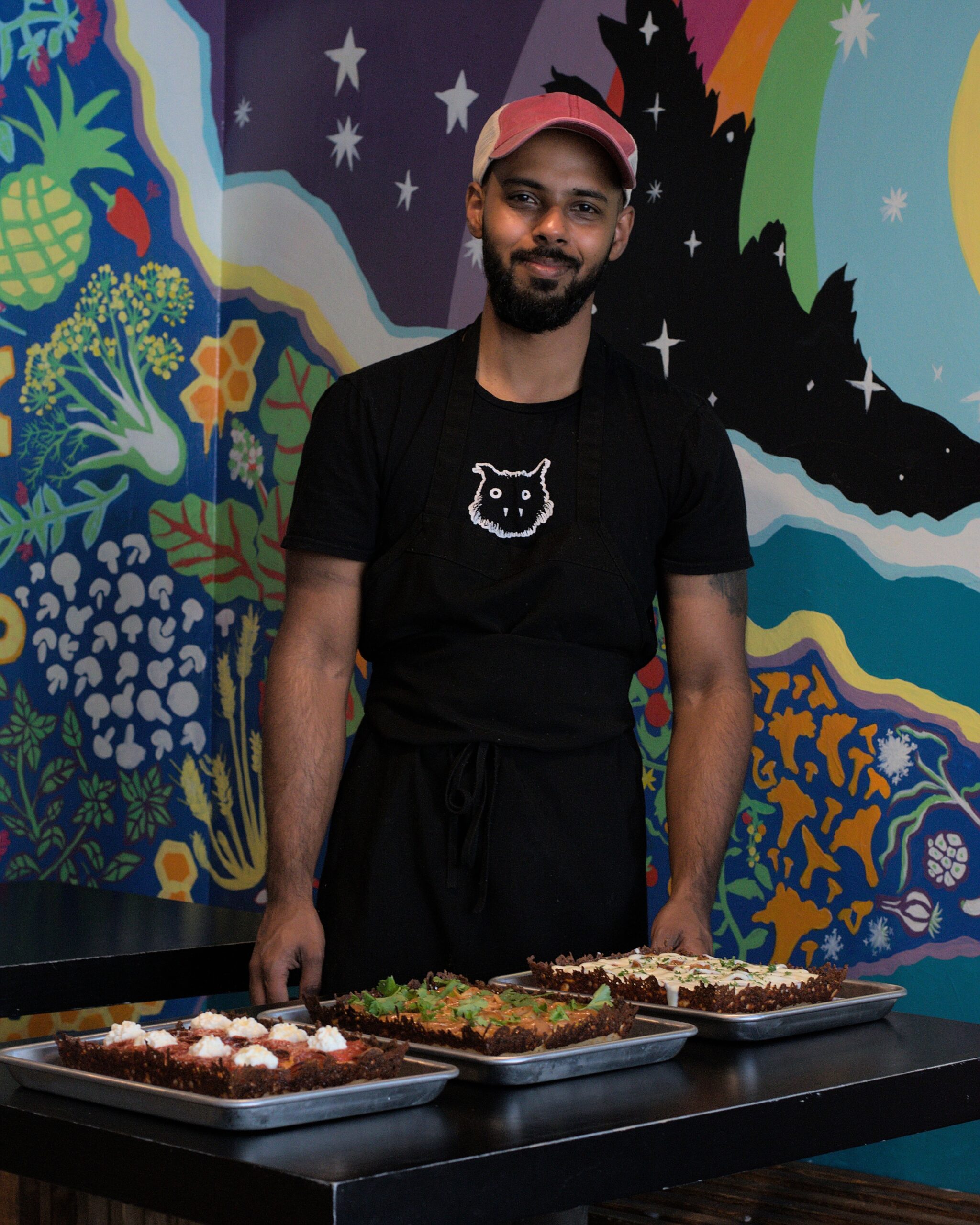
Black Cat Pizzeria in St. John’s, Canada’s most easterly city, is home to three unique styles (and counting). We spoke with owner Albin Jose Toms by phone about bringing Detroit-style pizza to the friendly city, what styles he likes to experiment with, his career path and more.
The independent shop, which is primarily pick-up and delivery but also has seating for about 20 that fills up fast, has operated at 13 LeMarchant Rd. since March 2024.
When Toms immigrated from Kerala, India, years ago, he encountered what he calls “Newfoundland style” that is widely served in the province and essentially a pan pizza: Greek-style with a thicker crust. While working at a pizzeria, he used his spare time to learn to make Detroit-style pizza, a specialty on which he built Black Cat.
Black Cat’s styles and unique selling proposition
What makes this pizzeria’s product unique? “The first thing that comes to mind is our use of sourdough,” Toms says. “Our dough is really nice. The base is a big part of it – we use all-natural fermentation and we make sure there are no enhancers to get a good, healthy product.”
“I see this as a new age of D-style pizza,” he says. He credits award-winning pizzaiolo, the late Shawn Randazzo, president of Detroit Style Pizza Company, with starting a new age of D-style.
The style is distinctive for its square or rectangular shape, thick, airy crust, crispy caramelized cheese crust and sauce ladled over cheese and other toppings. It’s also practical, says Toms, “D-style can handle more wet toppings and still hold up. For customers, it’s a lateral move from what they’re used to.”
Lately they’ve been making three distinctive styles using three different doughs: Detroit-style, Chicago thin crust, served on Wednesdays and Thursdays, and New York-style slices for Thursday lunch.
Toms says making multiple styles requires planning and offering some styles in a limited way helps. “With Chicago and New York, you can get by making dough only once a week,” he says. “We have to put all of our effort into our D-style because it’s what we’re known for.”
He enjoys the challenge of making New York-style, which he describes as “finicky” and shares knowledge freely with his team. “It’s like an Open Source when you’re working with me. When they are ready and when it is time, I want my team members to be better than me. We want the dough to taste a certain way, so we push the fermentation to the limit – which is nice for taste and nutrition.” However, he cautions that, after a certain point, dough will start losing strength and become hard to stretch.
They make sourdough garlic knots from New York dough. “It’s malleable for that – something about all the folding,” Toms says.
The entrepreneur enjoys experimenting with new and interesting flavours. “I was always interested in incorporating local ingredients into the pizza: garlic scapes, wild ramps, chanterelles, local lamb for sausage,” he says. “This is something we’re keen on.”
Cat’s Favourite is a bestseller. It features pepperoni, mozzarella, ricotta and hot honey, topped with red pizza sauce on sourdough crust.
“It’s not a very spicy pizza but [people like] the saltiness of the pepperoni, the sweetness of the honey and the smoothness of the ricotta. It’s a very balanced pizza.”
The job that became a career
An experienced pizzeria operator, Toms opened Black Cat in 2021 as a pop-up one day a week in collaboration with Terre fine dining restaurant. On Tuesdays, when Terre was closed, Toms would take over. In the summer, they operated dinner service on the patio.
They spent a year at Terre and another year sharing space with a doughnut bakery that was open during the day while the pizzeria operated at night, he says.
He says this approach can be challenging but a good way to test if your business is viable. “We had a contract, operating two businesses in one,” he says. “It’s a hard thing to achieve. Most people wouldn’t do it, but it was right for us.”
The move to an independent space didn’t go the way Toms expected. With rent so high, he planned to buy a location. “I knew from projections that the business would make money. I was adamant that I wanted to own the building. I spent time building up capital.”
However, many buildings were not suitable for a kitchen.
“I found a space to rent from a compatible, likeminded business. They knew my reputation was good in working with others. They knew the products because they were customers already.”
Toms studied mechanical engineering at Memorial University of Newfoundland. “I came to St. John’s to do a course and took a job at a pizzeria. I completed my course. Job opportunities were a little sparse, but I really like Newfoundland and wanted to stay there.”
He advanced quickly to become the manager and was offered a long-term job in exchange for help with their PR.
“I liked the work a lot. It started as a job, but somewhere along the way became more, says the self-taught chef. “You gain so much: a lot of soft skills, managing a team.”
The skills he developed working on mechanical engineering projects have helped drive efficiency in the kitchen. Says Toms, “There are a lot of key concepts in terms of how you make a product, workflow, how much movement is involved. You need open, clear communication between team members. I find it really cool, but there is a caveat: if you push it too far, you may end up sacrificing quality for efficiency.”
He and his team still shred their cheeses by hand and use sourdough. Says Toms, “It’s such a finicky thing to do fermentation on a commercial scale. Those are the inefficiencies that we happily accept to make our product better.”
Four-day work week
Toms leads a hardworking team of five.
He prioritizes treating employees well. That includes offering employees a four-day work week. The business is closed on Mondays and Tuesdays.
“It’s nice for the operator and very nice for the employees as well, so they are assured two days off in a row,” he says. “All of my staff get a consistent three days off.”
Working four days means longer shifts. “The experienced staff want those longer hours,” he confirms.
Looking ahead
In future, the team plans to continue innovating. “We are always pushing to have new products,” Toms says. “We’re not super interested in opening another location. I’m not motivated by a lot of things that a new location would bring me: more people management, more stress. I’d rather have something really good and continue being good to our employees.”
“We’re feeding our friends here, and the friends of our friends. It will be nice to bring new things to our community.”