Artificial Intelligence (AI) has been one of the dominant driving forces behind technology acceleration in physical security for several years now, as providers highlight advances like more efficient video search tools and expedient data processing on the back end.
A subset of AI, still in its infancy in the security world, is generative AI. One of the major applications of Gen AI is an interface that would allow the user to interact much more easily and naturally with their security technology — in theory eliminating the need to navigate through clunky menus or spend precious time browsing lengthy reports for specific information.
The promise of Gen AI is a natural language, intuitive interface that delivers exactly what the customer wants almost immediately, and even makes useful suggestions they might not have even considered.
Alert Enterprise, a developer of identity and access management solutions, was early to the market on this.
The company began testing a Gen AI interface for its security systems management tool several years ago in the form of a chatbot powered by OpenAI’s ChatGPT.
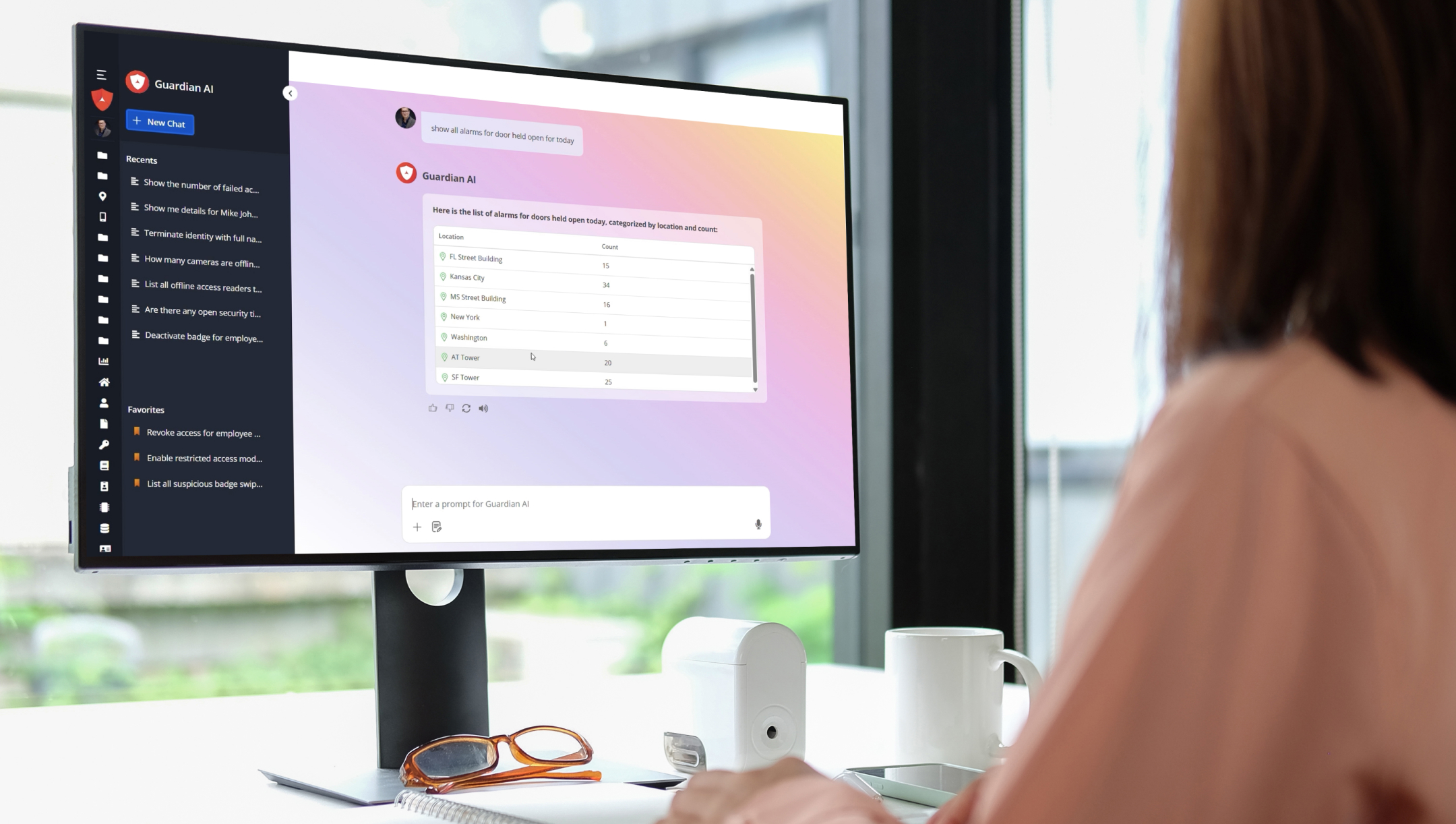
The Guardian AI Chatbot debuted in early 2023 at several security trade shows, including ISC West. The interface promised to “redefine the security operator’s experience, increasing their productivity by over 100 times with instant and actionable insights,” according to a press release issued by the company.
Since then, Alert Enterprise’s Gen AI interfaces have been refined and updated based on the continued evolution of the technology and the large language models (LLMs) that enable natural language chatbot functionality.
Gen AI “provides this amazing experience for rapid response to any question using large language models. They are able to find information for you in a way that is more useful than what we were used to from an internet search,” explains Willem Ryan, senior vice-president of marketing and communications at Alert Enterprise.
“We applied it specifically to physical security. We used the large language models from OpenAI to create a physical security model that answers specific questions about identity and access for an organization.”
Examples of this include, asking the interface how many employees or visitors are currently in the building, or which doors were held open and when. That data could be accessed previously, but required multiple clicks or menus in order to reach it. “Now you can just type in a question and get that information sent to you right away,” says Ryan.
Rapid growth
Generative AI (i.e. the ability to interact with an AI in real time and through natural language) has driven much of the public interest in the technology, and adoption has grown rapidly. Research firm Parks Associates recently released new data indicating that in Q4 2024, 47 per cent of U.S. households with internet access said that they had used a Gen AI tool, up from 40 per cent in Q1 of the same year.
Another Parks Associates study based on data collected from executives at home automation companies indicates the No. 1 use of customer-facing AI is for chatbots that provide technical support.
Jennifer Kent, vice-president, research, Parks Associates, says that most companies will rigorously test AI interfaces internally before allowing them to have any direct or primary contact with customers. “That’s a pretty common story that we’re hearing,” she says.
Common uses of AI inside corporations include research, software development, coding and marketing development, adds Kent.
The security industry in particular is using Gen AI to provide natural language descriptions of surveillance video footage, or using it to generate captions — something that both end users and police who must assess the nature of emergencies quickly would find useful.
While interest is high, and companies are rushing to get useful applications of Gen AI into the market, we are still in a “low knowledge, high skepticism moment,” as far as consumers are concerned, notes Kent. “They don’t know exactly what this is and can they trust it?”
Parks data reports that 69 per cent of U.S. internet households said they are concerned about society’s ability to control AI and use it responsibly. They are also concerned about data privacy implications.
In order to build trust with the user, says Kent, any use of Gen AI must serve the customer’s best interests first. “For companies who get it right versus companies who don’t get it right, they’ve got to make the customer feel like it’s working for them.”
Addressing data integrity concerns and taking next steps
Ryan says Alert Enterprise users have also voiced concerns about how an AI interface might potentially compromise data.
“When we were talking to customers, a couple of things became very clear,” he says. Customers sought assurances that there are guardrails in place to ensure that the AI does not exceed pre-defined operating parameters. In response, Alert Enterprise created a patented process that strips customer identifiers from the LLM, thus keeping sensitive information away from the AI interface.
As Gen AI began to grow in popularity, it also became clear that customers were standardizing on one of several enterprise AI options.
Alert Enterprise used an OpenAI interface when it first launched its chatbot two years ago, but has since created options to use LLMs from other major suppliers like IBM and Microsoft. Alert Enterprise also recently announced its Guardian AI Security Agent is natively available on ServiceNow, a cloud-based business automation platform.
The next major step forward for Alert Enterprise is “agentic AI” — a logical extension to the chatbot, Q&A format.
Rather than simply ask the AI a question and receive a response, the AI can be employed to perform certain tasks, such as extend or cancel employee access privileges. “It truly becomes an autonomous agent that gets rid of some of the repetitive work that humans had to do,” explains Ryan.
As the technology continues to improve and get smarter, Ryan says that more and more customers are coming to the company with a plan on how they want to use it in their own environments. Likewise, Ryan says integrators also want to talk about how they can leverage Gen AI tools to serve their clients and meet their growing needs.
However, he says, some things don’t change: customers still want the ability to audit their software, generate and store reports, and maintain full governance over any AI agents operating on their networks.
For more on security applications of Gen AI, read: Gen AI as cybersecurity enabler.