Many Canadian golf course superintendents and assistants aspire to volunteer their services at some of the PGA Tour’s more elite tournaments, including its major events. The experience is second to none, it’s a significant addition to one’s resume, and the chance to network with industry peers is invaluable.
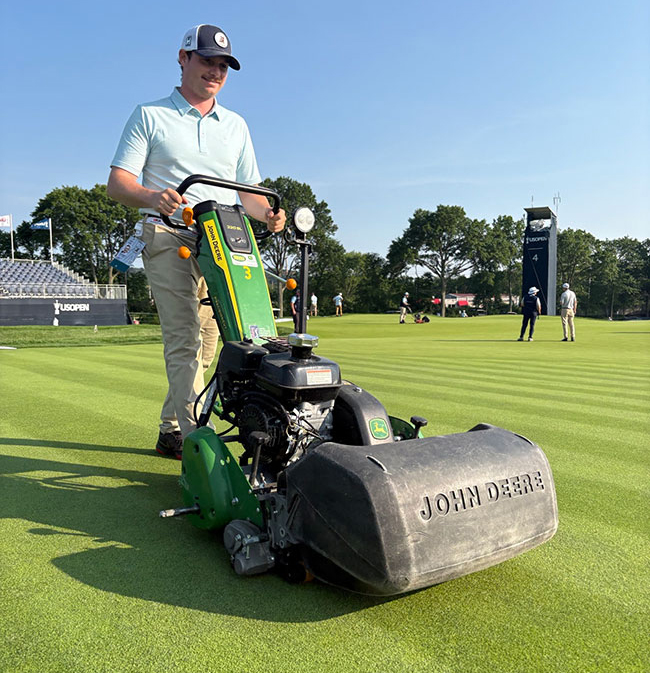
Such was the case for Connor Brown, assistant superintendent at the Oakville Golf Club, who joined the grounds maintenance team at the Oakmont Country Club in Pennsylvania during June’s U.S. Open week.
It wasn’t Brown’s first visit to Oakmont – he did his University of Guelph internship at Oakmont last year, helping with a major renovation project – but he saw a somewhat different golf course than what he had seen previously.
“Just seeing the rough like that was crazy,” he said of the thicker and deeper turf after returning to Oakville following the June 12-15 U.S. Open. “The rest of the golf course was perfect, but it just kind of felt like it was a whole other level of perfect.”
Brown’s primary role during U.S. Open week was to mow the approaches on the front nine holes – a task he performed both morning and evening. He also helped with bunker maintenance and positioning turning boards for the greens mowers.
Approaches were cut at a height of .220 inches which were a little higher than normal for Oakmont.
“The USGA wanted a little more definition between the green and the approaches,” Brown said. “Normally you can’t really tell the difference if you’re on the approach or on the green. That’s how tightly they’re mowed. That was the reasoning why they bumped it up.”
Brown was one of about 150 volunteers on board for tournament week, bolstering Oakmont’s own maintenance staff of about 50 individuals. To meet the stringent agronomic demands of the USGA, work got underway early in the morning and continued into the evening, well after play had concluded for the day.
On the Monday, Tuesday and Wednesday preceding the tournament, Brown and his fellow team members arrived at the golf course about 3:30 a.m., had a quick bite to eat and then were briefed by the club superintendent about the day’s tasks before receiving their assignments.
Early mornings, late nights
Work began at about 4 a.m. and continued until about 7:30 or 8 o’clock when the players began their practice rounds.
Brown said the roughs were rotary hand-mowed by one team while another followed behind to “fluff” it up. Crews began their workday at the same time once the tournament started on Thursday, but would either return to their hotel after work, stay behind to watch some of the golf or converge at the maintenance shop to watch golf on television, play table tennis or hit balls into a simulator.
“During the day, you could pick what you wanted to do,” he said, noting free time could also include catching up on rest.
Following the conclusion of golf on each of the first three days, work would begin for the evening shift which ended about 9:30 or 10 o’clock. Work generally began once golfers had made the turn or were playing their last few holes.
“I napped when I could,” Brown said. “It was a long week but well worth it.”
Brown said his “coolest” experience happened on the Sunday of the tournament which marked the final round.
“When it started to rain, I thought my duties were done because there’s no evening maintenance on that day.”
While sitting in the shop and watching the golf on television, awaiting its finish, Brown said Oakmont’s assistant superintendent rushed in to tell everyone to arm themselves with squeegees.
“I got to go grab a squeegee and went up to the 18th fairway, and I was squeegeeing water off the fairway at 5:30 on the Sunday night of the final round.”
Spectators who stuck around for the rain-soaked finish to the U.S. Open cheered and applauded the grounds crew for their efforts.
“It was something I had never experienced before,” Brown said. “It was very, very cool.”
He said key takeaways from his experience included learning about Oakmont’s agronomic practices and the club’s operations. Witnessing how the club managed its staff was particularly inspiring, he said, noting he was impressed by how well crews responded to the rain.
Volunteers at the U.S. Open were afforded the opportunity to take in various seminars in between their work shifts. Topics addressed included people management which Brown said was right up his alley because it’s a key role he fills at Oakville.
The U.S. Open wasn’t Brown’s debut at volunteering at a PGA Tour event. He had previously volunteered at a Waste Management Phoenix Open tournament, recalling it “rained a bunch” at the Tour stop where it rarely rains.
“It was different than most years at the Waste Management when they have one squeegee at the property and they’re trying to figure out how to get water off the green.”
Brown also volunteered his services a year ago at the U.S. junior amateur championship in Michigan. He said volunteering at such elite events gives him the opportunity to meet others in his profession from around the world. At June’s U.S. Open, he was partnered with an individual from Australia.
Brown said his dream is to complete the “grand slam” of volunteering at golf’s major tournaments. That leaves the Masters, PGA Championship and the Open Championship yet to fulfill.
Volunteering is hard, physical work, especially when it includes squeegeeing rain-soaked fairways and push-mowing 18 holes of five-inch rough, “but it was a lot of fun,” Brown said.
The current political climate in the United States was concerning, he said, when he first thought about crossing the border, but he said he experienced no issues.
“I was worried about it. There was another Canadian who tried to go down the week before the tournament, but he wasn’t let in.”