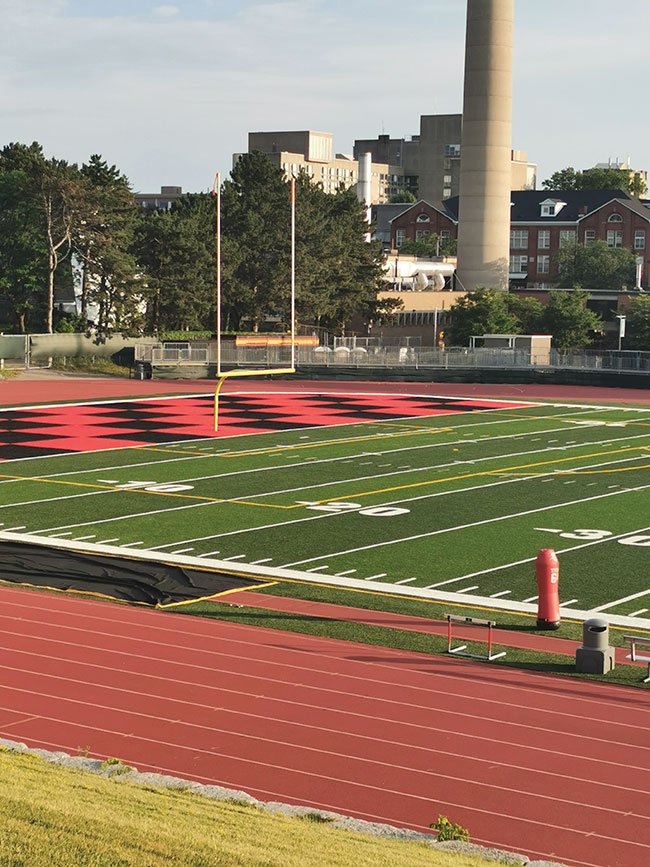
The installation of an artificial turf sports field isn’t a project that can be accomplished in a day. The average person on the street may think it’s simply a matter of placing a synthetic “carpet” atop the ground, allowing sporting events to be played upon it almost immediately afterward. It’s not that simple.
Cam Lawrie, facility supervisor for Alumni Stadium at the University of Guelph, outlined the elaborate process of installing an artificial turf field in February during the Ontario Turfgrass Symposium in Guelph.
In 2024, it was acknowledged the existing artificial turf surface at Alumni Stadium had reached the end of its life expectancy and needed replacement. The synthetic Turf Revolution surface was originally installed in 2012 and served as the temporary home field of the Canadian Football League’s Hamilton Tiger-Cats in 2013 while the team awaited completion of the new Tim Hortons Field (renamed Hamilton Stadium in 2024).
Lawrie said the former Turf Revolution field featured 16-millimetre fibres infilled with styrene-butadiene rubber (SBR) atop a gravel sub-base. It was replaced in the spring of 2024 with a GreenFields Allsport Diamond field with slightly shorter fibres, a 15-millimetre shock pad beneath it and infilled with SBR.
The field replacement project got underway on March 1, 2024. Although the playing surface itself had met the end of its lifespan, it was determined the field’s infill still had some life remaining and could be reused. Lawrie said that because the cost to dispose of the old surface was based on its weight, removing and reusing the infill helped to save money.
The infill was brushed into piles and set aside to be spread onto the new surface once it was installed.
Four days after beginning the project, work began to remove the older surface. Concrete saws were used to cut the fabric into smaller pieces for easier disposal. That part of the project was interrupted a few days later, however, when periods of rain and snow forced a two-week delay after almost half of the surface had been removed.
Lawrie said he anticipated the field replacement project would take about five weeks to complete, but the delay contributed to what became a 10-week undertaking, “but that’s the nature of that time of year.”
Turf’s arrival
The stadium’s new turf arrived on March 25 in 43 rolls that were removed from several trucks with a telehandler. Once the old turf was completely removed, it was discovered the gravel sub-base was uneven and required proper grading before the new surface could be installed. New material was added, and the sub-base was compacted accordingly.
“We wanted to raise the level of the base just a little bit so that it wasn’t a huge step down off the track to the turf,” Lawrie said.
By April 4, the field was ready for laser leveling. Lawrie praised the contractor’s leveling work prior to the arrival of the laser level which was used sparingly to finish the job. Another round of compaction followed before work on the sub-base was completed on April 8 – a 14-day project.
“It was an important part at this step to get it right.”
The process ensured the new artificial turf surface would remain flat and consistent over the entire field.
Laying out the new surface began April 10. Lawrie said little in the way of high-tech equipment was used during this stage of the project, with mostly tape measures and string lines utilized.
“It was pretty basic concepts they used.”
Reference points were marked directly onto the gravel to indicate where the sidelines, goal lines and midfield points would be located. Each roll of artificial turf was assigned a specific number to ensure it would be laid in its proper place on the field.
The first roll of new turf was laid on April 15. The shock pad was installed down one side of the field before being covered with rolls of the new surface material.
“It was very important to get these first rolls right because all your other rolls are referenced to this first roll.”
Lawrie said if the inaugural roll was positioned crooked or was a little off, each successive roll would be altered. Getting the first few rolls laid proved to be time consuming, but once they were down and formed a reference point, the rest of the process went smoothly, he said.
Lawrie said he was surprised to learn the shock pad was held together with packing tape but added that once it bore the weight of the surface itself and the infill, “it’s probably not going anywhere.”
About half the field was placed and glued together by April 16. Over the course of the next week, the remainder of the turf rolls were installed, work on the end zones had begun, and cutting around the field’s perimeter and at the corners was done.
Glueing in hash marks
Football-specific installations got underway on April 24, including the cutouts and glueing of hash marks along the sidelines and down the middle of the field. Fibres were shaved from the turf surface to accommodate the placement of marks and numbers. A “glue crew” was tasked with adhering the cutout marks and numbers to the turf’s backing.
Simultaneously, preparations were made for the installation of soccer lines so that they didn’t need to be painted whenever the field was used for soccer. Soccer lines were glued in April 28 while April 29 was earmarked for the Gryphons logo to be installed.
“This process was not a one-day thing,” Lawrie said. “This actually played out over a few days.”
He said the logo installation process took as long as it did because it came in multiple pieces bearing an intricate design that required some pieces to be glued in and be allowed to set in before other pieces could be added. There was still work to be done on the logo by the first of May.
Infilling began on May 2 – a process that was spaced out over a few days.
“It’s applied in thin layers over a period of days so that they can appropriately brush the fibres and get them to stand up so that none remain trapped underneath, and you get a nice, consistent surface.”
The field was finally handed over to the university on May 7.
Lawrie said there were several “weird” bits of plastic found on the field after it had been installed. He figured the pieces – which were brushed off the field – were part of the manufacturing process.
He said the new turf’s life expectancy is about 10 years, but suggested proper maintenance could buy it a couple more years.