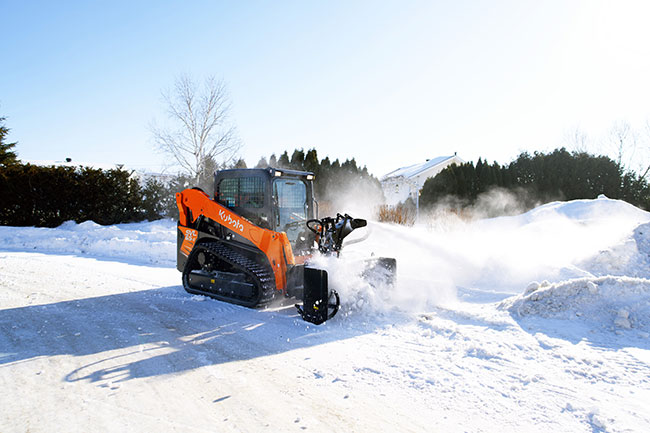
Winter’s arrival is just around the corner, and snow and ice contractors are getting their equipment and materials ready for the season’s first flakes. Snow and ice professionals have plenty of options at hand for clearing snow, including such attachments as front-mounted blowers and various types of blades.
Driving these attachments may include trucks, tractors, RTVs, wheel loaders or skid steers. Contractors may prefer one type of vehicle over another, but they should be aware of the strengths and limitations of available snow-clearing attachments, says Jonathan Gardner, product manager of construction equipment with Kubota Canada.
For example, not all blades are the same, he says. Fixed blades may not clean an uneven paved area evenly while articulated blades will do a better job when surfaces are uneven. V-blades, with their ability to expand and contract, may be better suited for clearing snow from sidewalks.
Contractors who prefer blades for pushing snow should pay careful attention to their blade’s cutting edge, Gardner advises.
“Make sure it’s not damaged. Make sure your cutting edge is in good shape because, without that, you’re not going to get down to the pavement or cement to clean the snow.”
He adds that attachments with moving parts should ensure the operator isn’t going to experience a “jolt” when going up and over a curb, thereby protecting the operator, the vehicle and the attachment.
“Make sure all those pieces are working and functioning,” Gardner says.
For hydraulic attachments, be sure the hydraulic lines aren’t packed, he says, and that they have no leaks. He adds that operators likely won’t be enamored to have to make repairs when outside temperatures are well below freezing.
“Snow removal is definitely a rough game.”
Looking for cracks in the frame and ensuring nothing is broken is something contractors must do prior to clearing snow, Gardner says.
Purchase considerations
If a contractor is looking to purchase new equipment, there are considerations to bear in mind, he says. Trip edges, for example, aren’t just there for clean snow edging. They help protect the operator. While clearing snow, operators tend to work as quickly as possible, knowing there are other jobs to be done within a limited amount of time. A snow-covered curb may be unseen, and the operator could injure himself if he plows into it without such protection.
“When it comes to repairing your equipment – safety-wise – make sure your seat belt is in working condition because you get those big jolts. If it’s a tractor or an RTV, you want to make sure your tires are at the correct pressure, and you want to make sure you have the tread depth to get the traction. If you don’t have the traction to clean an incline, you’ll slip and run backwards and end up in a ditch or something. Tires must be up to pressure and have the necessary traction.”
Good side lighting on the vehicle is imperative, he says, especially when snow removal work is frequently done at night when commercial parking lots are empty.
Although great strides have been made in recent years with the introduction of battery-powered landscaping equipment, gasoline and diesel power are the better options for winter work, Gardner says. Battery power in the winter is good for about four hours, he says, and it’s less with heavy loads.
“In snow removal, lots of times it’s heavy load, so now you take away time there. In cold weather, you lose battery longevity as well. When snow removal happens, you could be working four, five, seven, eight hours through the night, and you need a machine that has the hours of operation. You can’t stop to charge your battery for a day to go back and clean snow.”
This gives gasoline and diesel-powered machinery a “huge” advantage, Gardner says.
Most snow-clearing equipment can handle both heavy, wet snow and light, fluffy snow, but it’s a question of volume.
“If you’re doing a parking lot out west and you’ve got a foot of fluffy snow, you’re going to be able to gather more to push further than you would if you had that same amount with wet, heavy snow out east.”
Some attachments are built specifically for handling heavier snow. Gardner says purchasing a blower attachment than can handle heavier snow is a better investment than depending on one built for lighter snow that will have difficulty handling heavier loads.
Many contractors prefer to use compact track loaders for snow removal because they’re machines that can be used all year long and won’t be sitting idle during the winter months. Gardner said it is important that tracks have the proper tread depth.
“Tread depth is important to make sure that when you go out there, you’re getting the traction you need to remove the snow.”