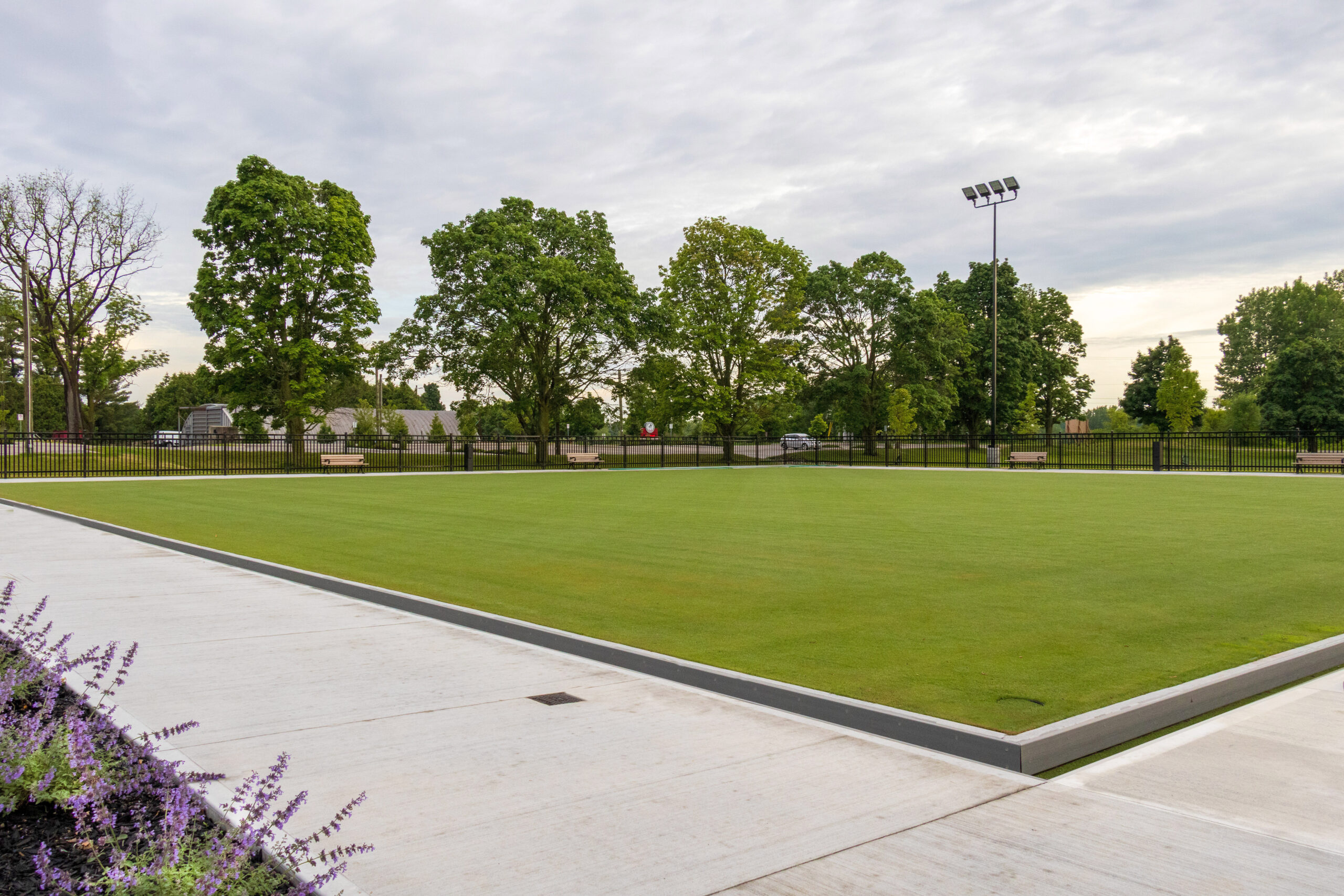
To the outsider, a lawn bowling green may look remarkably like a golf course putting green. The turf is mowed short, the surface is smooth, and it’s usually grown using bentgrass – a fine-textured, cool-season perennial grass – or another fine-leaf grass.
There are marked differences between a lawn bowling green and putting green playing surfaces. Golf greens tend to be undulated, forcing golfers to properly “read” how the bowl will roll toward the hole in terms of both speed and direction. Lawn bowling greens aren’t constructed in the same manner.
“A lawn bowling green has to be extremely flat so that when a bowl (the term for a lawn bowling ball) is bowled, it rolls true and allows the bowl to curl in or curl out, depending on what side the weight is on,” says Jason Winter, supervisor of turf and golf operations for the City of Brantford.
Lawn bowls are weighted heavier on one side, requiring bowlers to release the bowl in a manner so that it curls left or right at a precise pace towards its target.
The flat lawn bowling greens are crowned to within an eighth of an inch.
Winter was present each day during the construction of Brantford’s new lawn bowling green which opened for play in July at the city-owned Walter Gretzky Municipal Golf Course and Learning Centre. The former superintendent at Kitchener’s Deer Ridge Golf Club was on site to ensure the root zone, drainage tile and gravel layer met with the green’s design. Twelve inches of root zone mix was placed atop an imported gravel base.
“The root zone we selected was an 80-20 sand/peat mix that provided a good growing medium for the sod, and the city is very happy how it turned out in the first year of it being open,” Winter says.
The Brantford green was sodded to 007 creeping bentgrass which was selected for its disease resistance, tolerance to traffic, dense canopy and for its less water-demanding performance in the summer. Bowling greens are usually grown to such fine-leaf grasses as bentgrass or fine fescues. Among Ontario’s bowling greens are several older surfaces that have become a mixture of bentgrass, poa annua and perennial ryegrass… “a hodgepodge of different varieties,” Winter says. “The fine-leaf grasses are preferred for lawn bowling greens.”
Ontario’s nearly 120 lawn bowling clubs prefer to keep their surfaces trimmed to a height of between .120 and .250 inches (three to six millimetres). Tournament-hosting clubs and those regarded as higher-end facilities tend to mow toward the lower cutting height.
Winter says the new Brantford green was cut at a height of 4½ millimetres in its inaugural season.
“The new sod was cut higher for the initial season to ensure it had time to mature for the next season’s play.”
Golf superintendents have a good knowledge of maintaining turf at low mowing heights and will recommend to lawn bowling clubs the best slow-release fertilizers to use at preferred rates and frequencies. Winter says no more than 1¼ pounds of slow-release nitrogen will be used on the Brantford green over the course of a season. He says he does a lot of foliar spraying on the green but uses a granular slow-release fertilizer as a base.
Limited irrigation
Moisture management was key for the green to keep its playing surface healthy with minimal moisture required. Irrigation is limited during the season because greens play best when the turf begins to brown off and the surface becomes harder due to watering deficiencies.
“That’s when the green plays the best,” Winter says. “It becomes a bit of a balancing act to give it enough moisture to sustain life, but not so much that it makes the surface soft.”
Lawn bowlers understand that when a green starts to turn brown in colour, it means bowling will be good, he says, adding dry turf is better for managing disease.
“A golf green needs to be firm to receive a shot, but a lawn bowling green needs to be hard so that you get that perfect trueness of the bowl when it’s released, and it doesn’t leave a dent when it’s bowled. The firmer the better with a lawn bowling green.”
A bowling green’s “trueness” is a bowler’s foremost desire, Winter says, adding it goes hand in hand with smoothness and consistency.
“That’s really what they’re interested in so that when they release the bowl, they know it’s going to follow the line they release it on.”
Walk-behind reel mowers are used to cut the 120-foot by 120-foot greens. The surfaces are mowed diagonally, from corner to corner and alternated from the opposite corners for each mowing session.
“You don’t mow with the direction of the bowling,” he says. “This prevents the bowl from being influenced by any kind of grain.”
With each subsequent mowing event, the operator avoids cutting along the same path as the previous cut to prevent “burning in” of the turf. Bowlers alternate bowling from a north-south direction over a few days before switching to an east-west pattern.
“That helps to manage the traffic on the bowling surfaces.”
Most traffic occurs where the bowlers are standing. Alternating the bowling direction helps to manage stress on the surface and avoids areas of the green from becoming worn.
Maintenance of bowling greens is generally left in the hands of the individual bowling clubs which are largely administered by volunteers who have no formal agronomic training. Many clubs rely on the assistance of a local golf course superintendent who may be called upon to diagnose such irregularities as disease, weed or insect pressures. The superintendent will make recommendations about fertility, grooming practices and other necessary measures.
Advice to volunteers
They will also point out things volunteers should watch out for and to be contacted if anything appears to be amiss.
If a green is built of a sandy mixture, localized dry spot tends to be a common problem, Winter says, adding insects will always be a threat.
“It’s important to manage fertility, adopt good cultural practices, and constantly monitor for any diseases you may get.”
To keep greens as pristine as possible, volunteers are advised to remove dew from the surfaces each morning, roll or “polish” greens frequently to stave off such diseases as dollar spot, regularly brush the turf, and delay irrigation for as long as possible to avoid overwatering.
Verticutting is done in the spring and fall while grooming, brushing and rolling are commonly done throughout the season. Topdressing is usually reserved for the shoulder seasons.
“There’s very little topdressing on the bowling greens in season. It just doesn’t lend to a good playing surface with sand on it.”
Like golfers, lawn bowlers don’t want anything to impact the green’s performance during the playing season, such as aeration, Winter says.
“Everything is pushed off to the shoulder seasons. With putting greens, you still need to do some topdressing during the season for smoothness. A lawn bowling green is smooth because of how typically dry it is.”
Greens are generally mowed and rolled three to four times a week.
“Overall, lawn bowling greens are much leaner and a lot firmer than what putting greens are.”
While stimpmeters are used to measure distance on golf greens, a device called a green speed ramp or bowls green speed tester is used on a bowling green to obtain similar information.
“It’s similar to a stimpmeter where you release the ball and measure the distance in both directions and take the average,” Winter says. “Lawn bowling greens are measured by pace, so it’s the time it takes the bowl to roll 27 metres.”
A club’s top bowler is usually called upon to roll the bowl 27 metres while another club member notes how much time it takes the bowl to reach that distance. Ten seconds is considered slow, 12 seconds is average, and 14 seconds is regarded as fast.
Winter says several of the Brantford club bowlers are deadly accurate with their releases.
“It’s amazing how good a feel they have when they release the bowl. It’s interesting to watch them play this game.”