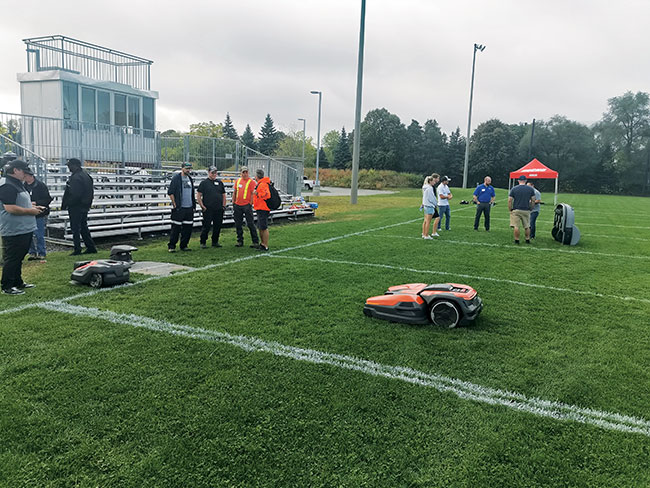
Technological improvements continue to allow autonomous mowers to evolve. Software upgrades have been made within the past year, allowing for more efficient mapping, and new research and development is enabling machines to have different numbers of cutting blades and allowing for lower mowing heights.
“It’s still a product that’s a work in progress,” Cody Cook, tech and robotics service specialist at Echo Power Equipment (Canada), said at September’s Canadian Sports Fields Association’s field day in Brantford. “Even though we’re happy with it, we want to try to make it better.”
Echo autonomous mowers were demonstrated throughout the day at the Wayne Gretzky Sports Centre, giving field day attendees a close-up look at their capabilities. G.C. Duke Equipment Ltd. also demonstrated Husqvarna robotic mowers.
The latest breakthroughs in technology have allowed autonomous mowers to produce a better quality of cut than before, Cook said.
“The fact that I can run everything for this robot off a 1,200-watt inverter just shows how small are the power drives,” he said.
The Echo mower demonstrated at the park’s multi-purpose field was capable of mowing about three-quarters of an acre between charges. A mower’s cutting time duration on a full charge is dependent upon the ground’s terrain, the mapping and the amount of its traversing.
“The idea is you’re using this in the middle of the night when nobody’s around, so you can let it cycle, let it run, let is cycle, let it run,” Cook said.
One of the biggest selling features of autonomous mowers is that they free up personnel to tackle other jobs while the machines are cutting fields. Cook said they address labour shortages and “never call in sick.”
Difficult to steal
Autonomous mowers are virtually theft-proof. With real-time kinematic (RTK) positioning already in place, a mower taken from a field and placed in the back of a truck would trigger an alarm connected to a phone app.
“You’d know exactly where it’s going,” Cook said, noting that of all the Echo autonomous mowers put to work in Canada and the United States, only one has ever been removed from a job site. Its GPS-tracking safeguards allowed it to be recovered in only a few hours.
The mower showcased at the field day also weighed about 187 pounds, adding a further challenge for would-be thieves.
The same unit was equipped with standard cutting heads which provided a mowing height range from 35 to 100 millimetres. Lower height heads are also available to allow for mowing as low as 12.5 millimetres.
It “very easily” meets FIFA cutting standards, Cook said.
“We’re trying to get it to the point where we can cut fairways.”
Golf courses are starting to embrace autonomous mowers for cutting roughs. Cook said two Canadian courses have gone fully autonomous with Echo products while a couple more are poised to begin in 2026.
“They’re up and running, and everything’s going well.”
Echo’s autonomous mowers are equipped with sonar which will detect obstacles blocking its path, preventing physical contact to be made. The units can be programmed for a set period to wait out the obstacle. If a mower should become stuck, it will set off a phone alert.
Further enhancements to autonomous mowing continue to be presented, especially around battery technology, Cook said.
“Battery technology is always changing. With battery technology, we get better run time out of these machines, and the more run time you can get, the more productivity you can get.”
The autonomous mowers are intuitive enough to know when their battery life is almost spent and it’s time to return to their charging stations. If it’s positioned at the opposite end of a field from its charging station, it will accurately determine the time and battery life it needs to return to the station.
“It always gives itself a little extra leeway.”
Mowing in the rain
Paul Turner, manager of municipal sales at G.C. Duke Equipment Ltd., demonstrated a Husqvarna autonomous mower at the field day, explaining that battery capacity determines the length of time a robot can mow on a single charge. He noted a model that can mow for almost seven hours on a charge, equating it to that of an almost full workday.
“It’s all about battery time, and how quick you can mow depends on how many acres,” he said. “It gives a great quality of cut, and you can mow in the rain. It’s not afraid of the rain.”
During rain events, mowers can continue to work and not remain at their docking stations.
Turner said everything the operator needs is on the fleet app, noting where the mower is and what robot is cutting where. The information is available for a phone, tablet or computer.
“Without a doubt, they’re changing the game,” he said.
Turner said there are currently 16 different models of Husqvarna robotic mowers available on the market, and three to four new models are added each year. Available products include four-wheel-drive and articulated models as well as those that adhere to slopes of 50 to 60 degrees.
“You can run as many robots off a reference station as you want,” he said, noting a station can be set up somewhere in a city, allowing each robot to communicate with it within a 25-kilometre range.
“We have a mower for everything…every application…slopes, small areas. I really think it’s a game changer. The consistency is unmatched. It’s repeatable. The end users aren’t going to get mad at you. You’re never going to see a clipping on any field you mow with a robot. The idea is to see no clippings.”
Robotic mowers are meant to keep short grass short, Turner said. “We’re not coming in to knock off three inches.”
He added robotic mowers allow for less reliance on fertilizer and water.
“The nutrients going back down will produce a better stand of turf for you.”