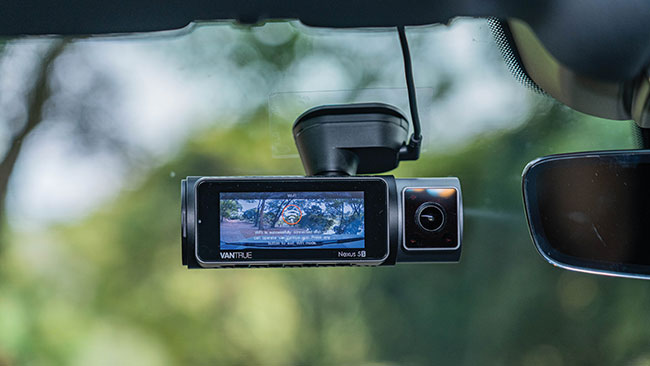
Landscape contractors and lawn care professionals are getting savvier about how technological advances can not only enhance their bottom line but can help to keep their labour forces safer and more productive.
Transitioning to battery-powered and autonomous equipment has helped companies save on fuel costs, address labour shortages and allow work to be done during hours often outlawed due to noise restrictions.
Technological breakthroughs don’t stop with the means to perform on-site work. Travel between job sites and to and from company depots can be impacted by modern technology, helping businesses to better track their crews’ driving habits, optimize travel routes, minimize fuel consumption and defend against fraudulent insurance claims.
Many landscaping and lawn care businesses have installed dashboard cameras (dashcams) in their company vehicles in recent years to safeguard themselves against staged collisions and exaggerated minor accident claims. While on the road, video footage is recorded from front-mounted and often rear-mounted cameras that can provide irrefutable evidence to determine if an accident was staged or if a minor accident is blown out of proportion. Without such video evidence, many landscaping and lawn care companies would incur higher insurance premiums they might not be able to afford.
At a job site, company trucks are often parked along the street, leaving them vulnerable to being clipped by another vehicle or to the theft of inside items. Many dashcams feature a parking mode which detects movement nearby and begins recording footage of a break-in attempt or the impact of another vehicle. In either situation, the recording will provide the evidence that insurance companies and the authorities will need to see.
“Road safety is very important, and I believe a dashcam can help,” George Chen, CEO and founder of Vantrue says. A manufacturer of dashboard cameras, Vantrue has been in business since 2015.
Peace of mind
Chen says dashcams give drivers peace of mind, providing them with greater assurance while they’re behind the wheel because they realize video footage is being recorded.
Today’s dashcams produce up to 4K-quality video, enabling a clear picture of another vehicle’s licence plate, even after dark or when it’s raining.
Dashcams can either be hard-wired into a vehicle or plugged into its electrical outlet, often referred to as a cigarette lighter socket. The advantage of hard wiring is that it enables the dashcam’s parking mode for round-the-clock protection. A lower powered voltage can be set up to prevent the vehicle’s battery from draining.
Chen says about 40 per cent of Vantrue’s customers have their systems hard wired to allow for parking mode operation.
A new feature introduced this year on dashcams designed specifically for commercial, high-demand, and professional drivers is thermal imaging which can depict large animals darting across the road or pedestrians walking along the shoulder before the driver is aware of their presence.
“It can see things in the foggy weather by the temperature of the body,” Chen said, noting the feature is also helpful when driving after dark or in heavy rain. Heat signatures are identified to provide early alerts to the driver, allowing him to exercise caution.
In addition to producing a video record of a vehicle’s movements, other dashcam features promote better driving habits among operators. Some systems with AI can detect dangerous driving habits such as speeding, hard braking, lane drifting and distracted driving, including cell phone use while in motion. Dashcams equipped with an interior cab camera will capture other driving faults, including vehicle operation with an unfastened seat belt, allowing company managers to review the footage and better train their employees so that they adhere to a safer driving culture.
The Allstate Insurance Company of Canada reports the three most common types of road collisions are rear-end accidents, lane-changing incidents and single-vehicle crashes. Most of these accidents occur in January, with December and February, respectively, reporting the next highest incidents.
“Rear-end crashes can stem from following too closely, busy urban traffic, sudden slowdowns, poor weather conditions, and more,” George Ljubicic, agency manager at Allstate Canada, says. “With the colder months ahead, drivers should be aware of the risks of slippery roads and maintain more space around their vehicle to safely brake.”
Mitigating poor driving habits
Turf care company vehicles often travel along highways or busy arteries, and drivers can be lulled into maintaining higher speeds once entering residential areas or they may tail too closely behind another motorist. Dashcams can help mitigate such poor driving habits.
Drivers of company vehicles who are motivated by the various features that dashcams provide will lessen their chances of being involved in accidents, allowing companies to extend the lifespan of their fleets, reduce downtime and bolster the efficiency of their businesses.
Inefficiencies in route plotting can be identified through GPS tracking data which can lead to reduced fuel consumption and time spent idling. Enhanced productivity comes from better route planning, and GPS tracking allows managers to keep better tabs on where their company’s vehicles are located.
Dashcams are available with various features and at different price points for commercial operations. Some are equipped with dual camera capabilities, depicting what is taking place in front of the vehicle and inside the cab. Other dashcams feature a rear-view camera for a more rounded picture of the vehicle’s surroundings.
Video quality can vary from one dashcam to another with resolutions ranging from 1080p to 4K. The original marketed cameras were 720p quality but have since evolved. The higher resolution can better capture licence plate numbers and other details.
Cloud connectivity allows video footage to be uploaded automatically and be readily accessible.
Real-time alerts can prompt drivers to adjust to any unsafe driving behaviours they have adopted.