The role of the landscape contractor is no longer limited to simply designing landscapes that can adapt in a world challenged by climate change and other environmental factors. Contractors must also run their businesses in a manner that will adapt to a changing world.
So argues Heather Jerrard, owner of London, Ont.-based My Landscape Artist, who advocated for the adoption of artificial intelligence (AI) at January’s Landscape Congress in Toronto.
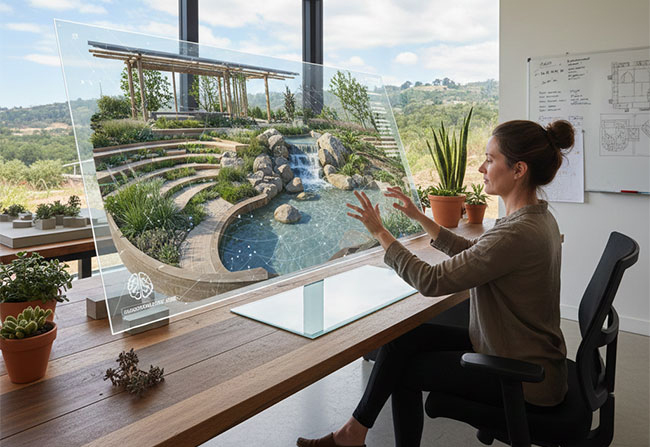
“As designers, we rely heavily on visualization,” she said, adding it enables better client alignment. “Better alignment means happier clients. There are fewer misunderstandings and fewer revisions.”
Using tools such as AI streamlines processes, reduces friction and builds resilience, Jerrard said. She noted AI does the “heavy lifting,” but the thinking is hers.
She was adamant in believing human beings won’t be replaced by AI, saying she prides herself in being genuine and transparent.
“Over the last six months, my own perspective on AI has changed a great deal.”
Jerrard said her adoption of AI in her work doesn’t make her less human but produces a better version of herself, equating AI to having an assistant with 2,000 arms that can easily juggle four balls so that she can focus on juggling two.
AI helps to explore ideas faster, she said, yet it doesn’t replace the designer nor signs the drawings.
“If you are presenting an AI-generated drawing, make sure you’re selling it as a conceptual visualization and not a design.”
It isn’t creativity but acceleration, meaning the designer is the author with more options to be explored quickly and efficiently during the early design process, ensuring a better final design.
Jerrard argues that technology is protecting craftmanship rather than replacing it.
“Power tools didn’t end carpentry and AI won’t replace us.”
Technology should do the repetitive work, allowing landscape designers to do the thinking, designing and problem solving – “all the things that got us into this profession in the first place.”
AI is the next big thing, she said, believing that adopting it allows landscapers to stay current and competitive, adding those who learn how to use AI and implement it in their businesses will replace those who choose not to embrace the technology.
“If AI can improve the quality and efficacy of a sales tool, wouldn’t you try it?”
One of the AI tools she has recently explored are sunglasses that record the video and audio of an initial conversation with a client. The video and audio are given to AI which produces a transcript of the meeting, including small details which are apt to be missed if only manual notetaking is done. An AI agent creates a detailed proposal for what needs to be included in a design as well as the next steps or information missed from the client interview.
It also prompts a reminder to email the client to ask for a survey. The overview of the client meeting is waiting in a desktop folder by the time the designer returns to his or her studio.
The process is a time saver, “and that’s where the money lies – in time saved.”
Challenge of climate change
Landscape contractors and designers continue to be challenged by climate change and other environmental factors. They are seeing certain plants fail that had previously thrived. It has led to clients asking more informed questions.
“Designing beautiful landscapes is not enough anymore,” Jerrard said. “We must work with the land, not against it. We’re creating places that contribute ecologically rather than spaces that just consume energy and water.”
She said the right plants are no longer being put in the right places because the right place has changed. She likened the reasoning to someone buying a puppy at a pet store, only to see it die before returning to the store and asking for a refund. It’s the same with plants.
The world is rapidly changing with climate, technology and society shifting simultaneously, she said.
“Climate change isn’t theoretical anymore. It’s operational. What we do as land stewards matters.”
Projects now take into consideration such things as the weather, plant performance, staffing and supply chains.
Landscapers are designers of ecosystems, Jerrard said. They work with time, soil, weather, animals and people.
“The landscapes that we shape throughout our careers are going to last long after we’re gone. The work we do matters.”
Jerrard cited four actionable things landscapers can encourage their clients to do to promote ecology.
- Create a “bug snug.” By foraging objects such as fallen branches and other natural material found on the property, an obelisk can be crafted for “creepy crawler” habitat.
- Wait for 10 consecutive days, during which the temperature is at least 10 degrees Celsius, both day and night, before doing spring cleanup. Waiting for days to sufficiently warm up gives hibernating insects a chance to “wake up.”
- Leave areas of exposed soil. Leaving certain areas intentionally exposed without mulch cover provides ground-burrowing bees with a habitat.
- Leave some areas intentionally wild. Everything doesn’t need to be manicured. An area of the landscape can be designated for ecological beings.
Jerrard said a landscape professional’s future is part artist, part steward, part technologist and part educator.
“Our systems need to be clear, our processes need to be streamlined, and we need to be fluent in technology and informed about environmental changes.”
She encouraged her audience to design and nurture gardens that will bring joy, create lasting memories and gently lighten the way of the world through thoughtful decision and genuine connection.