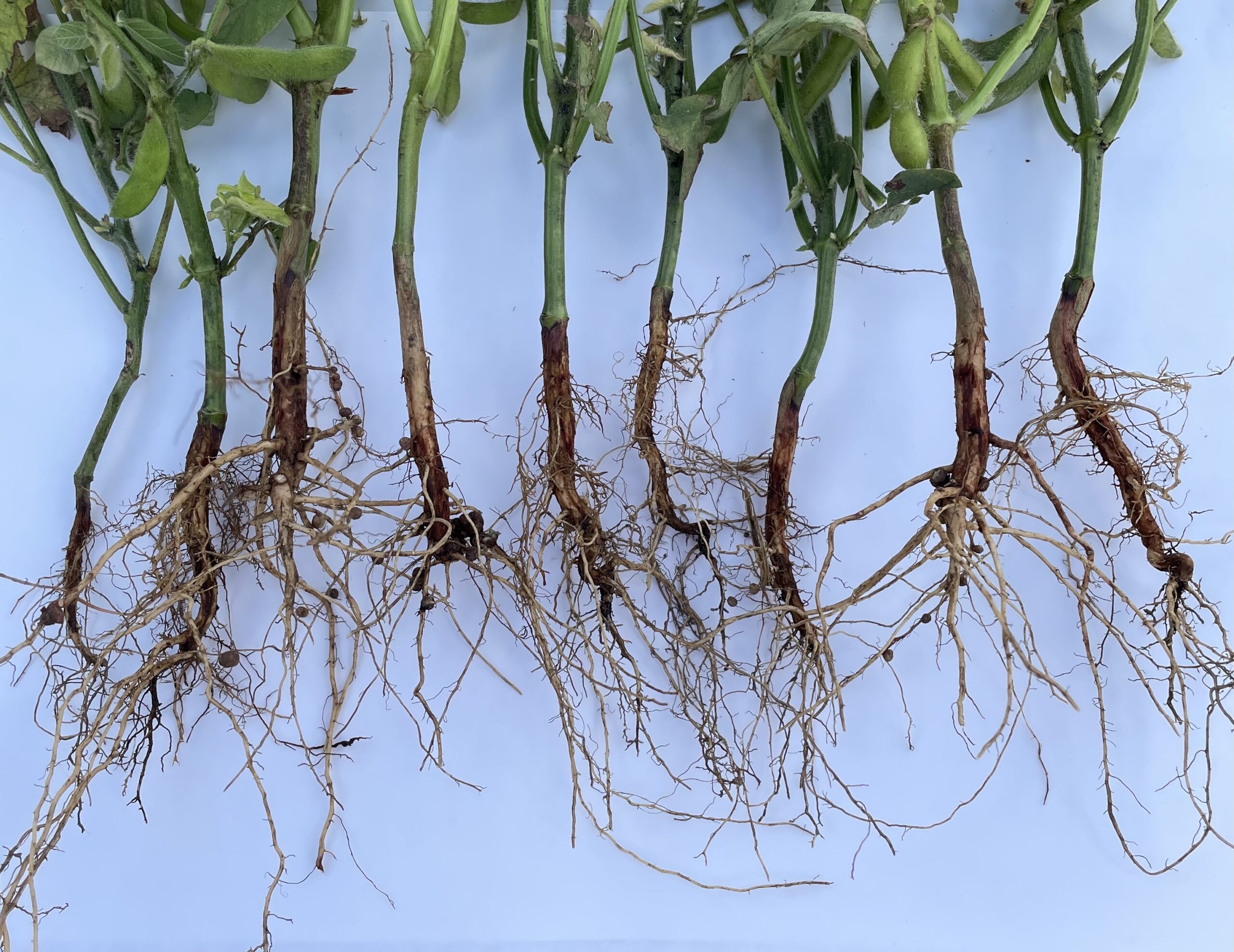
“Earlier studies showed that soybean root diseases are becoming more widespread and problematic in Canada, with new diseases emerging. In order to address this, we needed to expand co-ordinated soybean root disease surveys nationwide,” explains Yong Min Kim, a research scientist with Agriculture and Agri-Food Canada (AAFC) in Brandon, Man.
“This surveillance helps us identify emerging risks early and develop science-based solutions, which are crucial for effective risk management and reducing production losses.”
Kim is describing a key aspect of a recently completed five-year project, launched in 2018. Along with this national survey, the project included an assessment of soybean varietal responses to key root rot pathogens and an investigation of the genetic diversity and distribution of those pathogens. Also, the project monitored the spread of sudden death syndrome (SDS) in Ontario and established a disease nursery to screen soybean lines for SDS tolerance.
The project’s key investigators were Stephen Strelkov from the University of Alberta, Debra McLaren (now retired) at AAFC-Brandon, Owen Wally with AAFC-Harrow in Ontario, and Kim. However, Kim emphasizes that many researchers across the country collaborated on this major project.
Fearsome foes
As growers know, soybean root diseases are difficult enemies. The plant’s problems begin underground, so these diseases may go unnoticed until plant stand and yield losses start to become serious. As well, root diseases can be caused by various pathogens or complexes of interacting pathogens, but these different diseases may have similar aboveground symptoms, like wilting, stunting and yellowing, making diagnosis a challenge.
Although resistant soybean varieties are available for some root diseases, new pathogen strains may overcome that resistance. Other root diseases have more limited management options, such as increasing the length of rotations with non-host crops and using other practices for healthy crops, like proper fertilization and seed treatments, which can help reduce the disease but may not completely control it.
In addition, root diseases can spread into new areas, for instance, by the movement of infested soil on equipment. And an existing disease may expand from a minor problem to a more serious threat if changing growing conditions, such as shifting weather patterns, favour the pathogen.
A growing concern
The project’s surveys were carried out from 2018 to 2022 in Alberta, Saskatchewan, Manitoba, Ontario, Quebec and Prince Edward Island. Kim notes, “The goal was to survey about 160 soybean fields per year. However, due to some challenges related to the pandemic, not all provinces were sampled every year.”
To identify the pathogen species, the project team analyzed the collected samples in the lab, using morphological/microscopic and molecular methods.
Overall, the survey results show that soybean root diseases are indeed a growing problem.
“It’s safe to say that root diseases are becoming an increasing concern in Canadian soybean production. The impact can vary year to year based on environmental conditions, susceptible hosts and pathogen levels, but there are notable trends,” he says.
“For instance, Phytophthora root and stem rot is becoming more problematic in Manitoba, and soybean sudden death syndrome (SDS) is rapidly spreading in southern Ontario, where the disease’s range is progressing north and east. Interestingly, we found that root disease severity tends to be higher in eastern Canada – especially Ontario, where soybeans have a longer growing history.”
Root rot in every surveyed field
Root rot was confirmed in 100 per cent of the surveyed fields. Kim notes that several factors contribute to the widespread occurrence of root rots even in regions with shorter histories of soybean production.
One factor is that “many pathogens have evolved to infect a wide range of commercial crops including soybeans. Fusarium species can infect multiple crops and were found in all the surveyed soybean fields across Canada,” he says.
On the other hand, “some soybean root diseases, such as Phytophthora root and stem rot, were less common in provinces with a shorter soybean-cropping history.”
On a national basis, the predominant root rot pathogens found in the surveys were: various Fusarium fungi, including complexes of multiple Fusarium species; and Phytophthora sojae, a fungus-like microbe known as an oomycete, which causes Phytophthora root and stem rot.
Across Canada, the most common Fusarium species were Fusarium oxysporum, Fusarium acuminatum, Fusarium avenaceum and Fusarium redolens, with F. redolens being more prevalent in Western Canada than Eastern Canada.
Less commonly found Fusarium species included Fusarium solani, Fusarium graminearum, Fusarium equiseti, Fusarium culmorum, Fusarium tricinctum and Fusarium sporotrichioides.
Assessing soybean resistance
In greenhouse experiments, the team tested the effects of six different Fusarium species on 20 Canadian soybean varieties. Those six species were: Fusarium oxysporum, Fusarium avenaceum, Fusarium acuminatum, Fusarium redolens, Fusarium graminearum and Fusarium solani.
As expected, the response to the different Fusarium species varied depending on the soybean variety. None of the varieties had complete resistance to any of the pathogens, but some tolerant varieties were identified for each pathogen.
“We found that two cultivars, ‘P15T46R2′ and ‘B150Y1′, consistently showed tolerance to several Fusarium species including Fusarium oxysporum, Fusarium redolens, Fusarium graminearum and Fusarium solani,” notes Kim.
“This suggests that these two cultivars might have broad-spectrum resistance or tolerance towards multiple Fusarium root rot pathogens.”
Another interesting finding from the greenhouse work is that the Fusarium root rot severities measured in the experiments were generally greater than the severities reported in previous studies. That might mean that these root rot species are becoming increasingly aggressive in some cases.
An emerging root rot disease
One of the project’s unexpected findings was the detection of the fungus Macrophomina phaseolina in Manitoba. This pathogen, which causes charcoal rot, was already known to be present in Ontario and Quebec, and the project’s surveys found it in those two provinces, as expected. However, Macrophomina phaseolina had not been previously reported in Manitoba.
Kim says, “We published this as the first report of charcoal rot on soybeans in Manitoba and Western Canada. This discovery is significant because it highlights the need to consider this pathogen when developing resistant soybean varieties and screening for host resistance.”
He points out that charcoal rot is the sixth most destructive disease causing soybean yield losses in the United States. Although he notes that charcoal rot is not yet a major concern for Canadian soybeans, it could become a more serious problem if, for example, the hotter, drier conditions that promote this disease occur more often in our soybean-growing areas.
SDS and SCN
SDS and soybean cyst nematode (SCN) are both major soybean disease concerns in Ontario, capable of causing very high yield losses when conditions favour the pathogens.
SCN has been spreading across Ontario’s soybean growing areas since this microscopic roundworm was first detected near Chatham in southwestern Ontario in 1988. SCN was first found in western Quebec in 2013 and in Manitoba in 2019; in both cases, the nematode was at very low population levels.
The project’s surveys showed that SCN continues to be a serious issue in Ontario, but the pest was not identified at quantifiable levels in any of the field samples collected from outside of Ontario. This indicates that the nematode is only slowly expanding into newer soybean-producing areas.
SDS, which is caused by Fusarium virguliforme, was first found in Ontario a few years after SCN’s initial detection. Since then, the fungus seems to have been following in SCN’s footsteps across the province’s soybean fields.
Owen Wally led the project’s work on SDS in Ontario. “We observed that SDS has been steadily spreading across southern Ontario, including previously unaffected areas. And the number of positive samples have increased in counties where the disease was already present,” notes Kim.
“We also observed that severe SDS outbreaks consistently occurred in regions with high SCN pressure. And we found that environmental factors – particularly the timing of moisture – played a crucial role in the disease’s spread and severity.”
The SDS disease nursery was set up at AAFC-Harrow by Wally’s research group. Using SDS inoculation and irrigation, the nursery provides uniformly high SDS disease pressure, which is really useful for soybean breeders and growers who want to know which soybean lines have the best ability to withstand SDS attacks.
From 2020 to 2022, they screened almost 300 soybean lines at the SDS disease nursery as well as at a pre-existing SDS-infested field near Chatham.
Kim says, “Overall, these results highlight the benefits of a thorough approach to understanding SDS and finding resistant varieties, which is crucial for managing the disease in Ontario soybean production.”
Information and insights
“The results from this project offer valuable insights into the incidence and spread of root rot diseases, particularly those related to Fusarium species complexes and other important pathogens,” he says.
“This knowledge can help in developing effective management strategies for these diseases, which are affecting soybeans across Canada. Additionally, the results enhance knowledge transfer and technology sharing, supporting farmers and the industry in adopting innovative disease management practices.”
The project’s findings have also prompted Kim and his colleagues to start a couple of follow-up studies. One study is evaluating the effects of seed treatments and field tolerance to Phytophthora sojae in soybeans, and the other is assessing Macrophomina phaseolina resistance.
The project was funded by the Government of Canada’s AgriScience Program through the Canadian Agricultural Partnership, with industry support from the Canadian Field Crop Research Alliance. Kim notes, “I would like to recognize our collaborators in both Eastern and Western Canada, as well as the contributions from Manitoba Agriculture, Manitoba Pulse & Soybean Growers, Saskatchewan Ministry of Agriculture, Saskatchewan Pulse Growers, and Alberta Agriculture and Irrigation.”