Interest and investment in biological crop protection and fertility products has increased dramatically in recent years, but consistent and measurable benefits from such products remain largely elusive.
For Manish Raizada, professor in the University of Guelph’s department of plant agriculture, part of the problem lies in evolution – or more specifically, a lack thereof in biological input development programs. Raizada’s experience suggests effective biological products can, however, be developed through targeted evolution.
Breed, evolve, and select
The Crop Protection Network’s 2023 publication “Biopesticides for Crop Disease Management” argues more research is needed to “understand the efficacy of specific biopesticide products and their spectrum of disease control.” It also states research is required in a variety of other areas, including how biopesticides can be used effectively with synthetic pesticides – without sacrificing the efficacy of either product. Educational opportunities, too, are needed to help growers understand “the complicated terminology surrounding biological products and what factors can lead to their success (or failure) in a production system.”
Raizada reiterates many of the same points, but draws particular criticism to companies claiming their product will consistently work across a range of crops and conditions.
“That’s not what I see in the literature and it’s definitely not our experience,” Raizada says, referencing his own investigation into the validity of some efficacy claims. He later points to additional independent research from the United States indicating the yield benefits of nitrogen biological products remain elusive despite contrary claims from the manufacturer.
Raizada does, however, believe biological inputs have a bright future if companies “take the slow route” in the development of such products – that is, employ the “breed, evolve, and select” strategy widely used in the development of new crop varieties. Indeed, it is this method by which microbes that can seek-and-destroy fungal pathogens in corn and wheat are being developed.
Evolving disease-destroying bacteria
Raizada was involved in the “biological control and management of Fusarium head blight and associated diseases in organic grain production” – a Canada-wide project under the 2018-2023 Organic Science Cluster. The aim was to investigate if microbiome changes in corn silks and wheat rachis – the main stem of the plant – after fungal infection was defensive in nature.
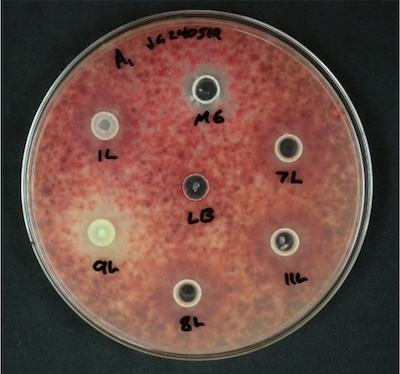
With this in mind, the researchers bio-prospected hundreds of microbes in corn silks and pollen identified as potential natural thwarters of Fusarium. These were cultured in petri dishes and tested for anti-Fusarium properties. Dozens showing positive results – and deemed safe to work with – were identified, and selected for further controlled indoor trials.
“From those trials the pollen microbes were promising, but the silks were actually the best,” Raizada says. Some of the leading candidates could reduce DON mycotoxins and “a suite of Fusarium” toxins by as much as 90 per cent.
A similar process was followed for wheat. In both corn and wheat, some microbes brought very significant results in a lab setting. Effectiveness was notably lower in greenhouse trials, though, and further reduced in field conditions. Of the hundreds of microbes they started with, Raizada and his colleagues were left with just a few potentially effective organisms. This includes just one microbe for wheat, which proved effective at reducing DON levels to below one part-per-million when applied as a late-season spray in conjunction with fungicide. Year-to-year variability was also observed – something Raizada says is “typical” of biologicals. They are now evolving the most effective microbes to be better at seeking and destroying fungal pathogens.
“We realize now we don’t have something that’s good enough for growers. There are a couple years to go at this point,” says Raizada, adding Grain Farmers of Ontario and the National Science and Engineering Research Council of Canada have provided additional funding.
“No seed company would sell one seed variety and expect it to work, but that’s what we’ve been doing with biologicals. We have to take the same approach that’s always been done in crop breeding or animal breeding.”
To-date, the researchers have successfully bred the most promising corn silk microbe into an organism that actively looks for and kills Fusarium. Like human immunity cells, Raizada says they are “literally moving towards the pathogen and chopping it up.” In summer 2025, this microbe will be tested in the field against the original started microbe strain. A similar process will eventually be followed in wheat.
Raizada believes their evolutionary approach will result in “a more potent killing machine” that could, one day, be a viable input available to growers. Many hurdles remain, including a lengthy regulatory process, and determining the best means of delivering the input – as a seed coating or spray, for example. He is excited with the success wrought by their approach thus far though, and hopes the ineffectiveness of biological products developed without evolution in mind does not spur a general backlash.
“I really think there’s a good future with biologicals,” Raizada says.