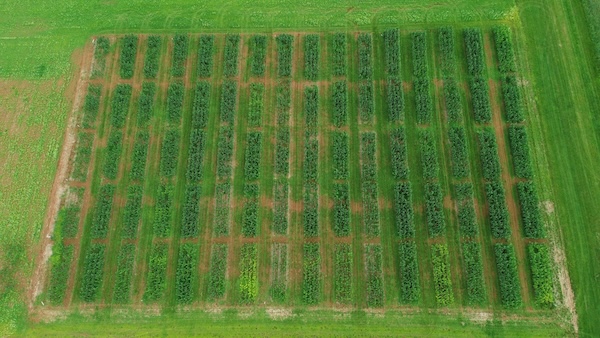
At the Harrington Research Farm in Prince Edward Island, two projects are troubleshooting how to save money on inputs, improve soil health, and better manage weeds with cover crops and herbicide banding in maritime corn silage and soybean production.
Andrew McKenzie-Gopsill, research scientist with Agriculture & Agri-Food Canada (AAFC), is behind both initiatives. With funding from the Atlantic Grains Council, by way of farmer checkoff contribution, and the AgriScience Program, under the Sustainable Canadian Agricultural Partnership, McKenzie-Gopsill is using cover cropping in corn and cover cropping with herbicide banding in soybeans to reduce input requirements for both production systems in the Maritimes.
Carryover benefits and weed suppression in corn
The cover crop initiative for corn production is comprised of two projects. The first project measures the impacts of corn planted into standing cover crops, and the second measures the impact of cover crops planted in-season.
The purpose of planting corn into standing cover crops for the first project, McKenzie-Gopsill says, is to determine if there is any carryover benefit from the cover crop to reduce input use.
Sorghum-sudangrass, crimson clover and a mixture of the two species, were planted in the spring for a full year of growth. Herbicide was subsequently applied the following spring, with corn direct seeded into the remaining biomass. Different nitrogen fertilizer rates were applied – from a control of zero to a 150 per cent rate of 167 pounds per acre. Now moving into the second year of corn planting, data from the first year indicates corn silage yields increased with nitrogen rate, when planted into sorghum-sudangrass, and the sorghum-sudangrass and clover blend. McKenzie-Gopsill says there doesn’t seem to be a plateau in this system.
In strictly crimson clover, however, silage yields dropped as nitrogen rates increased.
“We think what might be happening is some mismatch between nutrient demands and availability. Just too much nitrogen at the wrong time,” McKenzie-Gopsill says. And while crimson clover does benefit soil health, the significant biomass generated through a full season of growth tends to overwinter well, making it a challenge to manage without high rates of glyphosate the following spring he adds.
For the in-season cover crop project, McKenzie-Gopsill analyzed the weed suppression potential of annual ryegrass and yellow sweet clover planted at corn seeding, or at V6 growth stage. These two species were chosen from among several other species after previous trials indicated they performed the best – having the least impact on silage yield – while providing ample grazing forage post-silage harvest.
“We’re doing our best to ensure it’s all tetraploid annual ryegrass,” he says, referencing herbicide resistance challenges, which have developed in some rye grasses in other parts of the world.
Weed control from annual ryegrass seeded at V6 was statistically equivalent to using an herbicide for control, as of V9 growth stage – and this includes no impact on yield. Yellow sweet clover seeded at V6 also brought no yield impact, but McKenzie-Godsill says weeds became “quite a bit of a mess” by V9. When cover crops were planted at corn seeding, silage yields decreased by 50 per cent or more.
Other data are being gathered from the two cover crop projects, including insect and pathogen measurements, as well as root analysis to determine possible nutrient transfer between cover crops and corn plants.
Adopting covers into corn silage production does bring challenges, though.
“Seeding at V6 requires the right equipment. A lot of the time, when broadcast seeding, a lot of that cover seed is going to get stuck in the whorls,” says McKenzie-Gopsill. He adds there are also few weed control options with the clover-corn combination, versus corn plus annual ryegrass.
Savings from herbicide banding
Four years of data in McKenzie-Gopsill’s soybean project show significant cost savings can be found by incorporating cover crops and herbicide banding into soybeans.
Six-inch row spacing in soybeans is typical in the Maritimes. For this project, McKenzie-Gopsill and his colleagues expanded to the 30-inch rows commonly employed in parts of the United States, between which either fall rye or tillage radish were established. Controls featuring standard six-inch rows, and 30-inch rows without cover crops were also established. All plots had the same seed population. Four different herbicide programs were being tested as well, including banding herbicide over soybean rows rather than standard broadcast application.
“We’re finding regardless of herbicide program, if we seed in fall rye in spring it has no impact on yield. We’re getting the same yield as our control plots of three tons per hectare,” says McKenzie-Gopsill. Radish, on the other hand, overgrows the soybeans and reduces yield by a third or more.
The benefits of banding herbicide are consistently clear.
“The environmental benefit is a 73 per cent herbicide use reduction with banding. It’s a pretty dramatic reduction in savings…Most soybean producers in the Maritimes really aren’t using any pre-emerge products. 90-plus per cent would just be doing a single glyphosate application at V3, or whenever they can get to the field. If people are going to use those pre-emergence products that are more expensive, banding really reduces the cost. All you have to do is modify your nozzle spacing and type.”