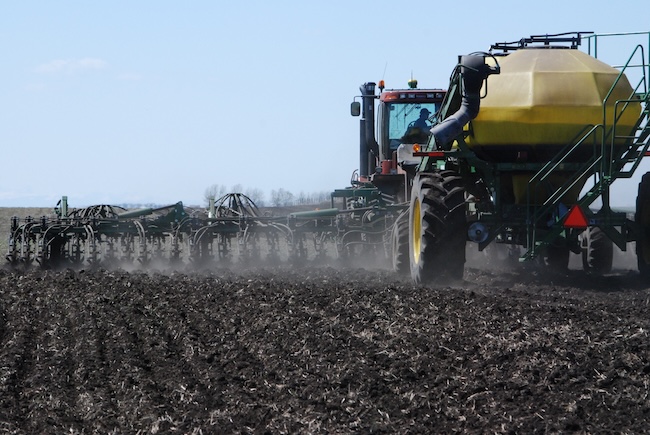
How much spring wheat do you seed per acre? A bushel? A bushel and one-half? Throw that old notion out and think plants per square foot. Current Saskatchewan recommendations are 21 to 27 plants per square foot (215 to 275 plants/m2). But is there an opportunity to fine tune those rates further?
“There is sufficient research to indicate that the optimum seeding rate of wheat may vary depending on environmental conditions,” says Jessica Enns, research manager with the Western Applied Research Corporation at Scott, Sask.
Enns was the principal investigator on a 2023 research project at six Agri-ARM sites in Saskatchewan. The research was conducted at Melfort, Yorkton, Swift Current, Indian Head, Prince Albert and Scott, Sask. The objective of the study was to evaluate the ideal seeding rate for spring wheat under various environmental conditions. The trial included seven seeding rates targeting plant stands starting at 10 plants/ft2 (108 seeds/m2) and increasing in increments of 5 plants/ft2 (50 seeds/m2) up to 40 plants/ft2 (432 seeds/m2). So, the rates targeted 10, 15, 20, 25, 30, 35 and 40 plants/ft2.
A typical hard red spring wheat variety that was common to the area was seeded into canola stubble at most sites, except Swift Current and Yorkton where it was seeded into durum and wheat stubble. Row spacing varied by site and was eight inches at Swift Current, 10 inches at Scott and Prince Albert and 12 inches at Melfort, Indian Head and Yorkton. Fertilizer was applied based on soil test recommendations – and weeds, diseases and insects were controlled as needed.
Plant emergence was measured at two weeks after emergence. Head density was counted when head emergence was complete. Tillering was calculated by dividing the plant density by the head density to provide the number of tillers per plant. Lodging was evaluated at physiological maturity. Head length was also measured. Yields were adjusted to 14.5 per cent moisture content. Protein was collected as an indicator of seed quality. Head size (seeds/head) was calculated based on yield, head density and seed weight.
The mean monthly temperature and cumulative precipitation were recorded at all six sites for the months of May to August. Overall, the above-average growing season temperatures and below average precipitation indicated relatively drought-like conditions for all six sites.
Plant densities increased
Splitting the sites into low and high moisture groups, plant densities increased for each group as seeding rate increased, but slightly differently. At low moisture sites, there was a significant linear response to seeding rates with plant densities increasing at a rate of 0.69 plants/ft2 for each increase in seeding rate. The lowest seeding rate of 10 seeds/ft2 resulted in a plant density of approximately 10 plants/ft2 rising to about 30 plants/ft2 at the highest seeding rate.
At the high moisture sites, plant densities increased as seeding rates increased but began to plateau at higher seeding rates. The lowest seeding rate had about eight plants/ft2 tapering off to about 28 plants/ft2 at the highest seeding rate.
Similarly, head densities tended to increase as seeding rates increased at all locations. However, head densities increased more with increasing seeding rates at the high moisture sites than low moisture sites.
As seeding rates increased, tiller density, head length and head size decreased at all locations, but to a greater degree at high moisture sites than low moisture sites. Lodging also increased with increasing seeding rates at high moisture sites.
Yield differences between sites
At low moisture sites the yields tended to decrease as seeding rates increased. At Indian Head, yields decreased from 76.1 bu./ac. at 10 seeds/ft2 to 74.7 bu./ac. at 40 seeds/ft2. For the Swift Current and Melfort sites, the yields were unaffected by seeding rate treatments.
“High seeding rates generally result in high plant populations, which compete more strongly for resources. When resources are limited, such as in dry conditions, high plant populations cannot acquire the necessary resources to be productive. Consequently, more plants mean that each individual plant may receive less water. Therefore, plants can become stressed, which negatively affects their growth, root development and productivity,” says Enns.
On the other hand, Enns says that when plant populations are low, limited resources are better utilized by plants, resulting in greater productivity and yields. She says this was the case in this study, as low seeding rates resulted in low plant populations and greater yields with greater utilization of a commonly limited resource such as moisture.
At high moisture sites the yields tended to increase as seeding rates increased. At Scott, yield increased by five bushels per acre from the lowest to highest seeding rate. At Yorkton, there was a 10 bu./ac. difference between the lowest and highest seeding rate. At Prince Albert, the yields increased as seeding rates increased and peaked at 35 seeds/ft2.
“When moisture is not a limiting factor, higher plant populations are able to acquire the necessary resources for growth and development. Additionally, greater plant populations can result in more potential for yield as the quantity of yield-determining factors also has the potential to increase,” says Enns.
The study found that head density was the most strongly correlated to yield. At high moisture sites, head density increased with increasing seeding rate, resulting in higher yields. Enns says there is often a diminishing return for increasing seeding rate, where high plant populations cannot acquire the amount of resources needed to support higher yields.
“While a quadratic yield response was not significant in this study, the confounding results indicate that optimum yields were most consistently achieved at 30 seeds/ft2,” she says.
Enns says the results show that the seeding rates to optimize yield vary slightly depending on moisture conditions. Based on the results of this study, seeding rates at 20 seeds/ft2 in low moisture conditions and 30 seeds/ft2 in high moisture conditions can consistently optimize wheat yields.
“It is difficult to predict moisture conditions for the growing season at time of seeding. But a basic understanding of this relationship between plant populations and moisture availability can help producers manage their wheat and mitigate risk,” says Enns. “Additionally, applying this concept to variable rate seeding may help producers optimize their yield and economics for wheat at the field level.”
Other agronomic considerations
Higher seeding rates can help plants better tolerate biotic and abiotic stresses, particularly when resources are not limited says Enns. One of the greatest benefits of increased seeding rates is greater crop canopy coverage. This can improve the competitive ability of the crop against weeds for greater weed control without relying as strongly on herbicide control. Additionally, a greater crop canopy provides more coverage of the soil which can reduce soil moisture losses through evaporation.
Enns says that denser crops may be able to better moderate the microclimate within the crop and stabilise temperature effects such as extreme heat. Another benefit of denser plant populations, particularly in wheat, is the reduced number of tillers. This can improve the precision and efficacy of fusarium head blight (FHB) fungicide applications for greater disease management.
“Ultimately, while low seeding rates may be beneficial when moisture is limiting,” says Enns, “higher seeding rates provide many agronomic benefits that low plant populations do not.”