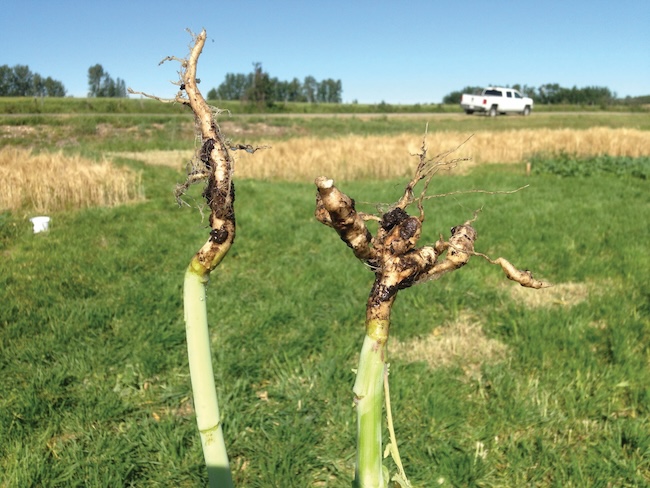
Clubroot-resistant canola varieties are a crucial part of strategies to manage this devastating disease, but the clubroot pathogen excels at defeating current resistance genes, especially if only a single resistance gene is involved. That’s why Christopher Todd and his colleagues at the University of Saskatchewan (USask) are working to identify many different genes involved in many different ways of combatting the clubroot pathogen.
Their long-term goal is to contribute toward development of stacked clubroot resistance involving multiple modes of action so canola varieties will have much longer-lasting, broad-spectrum clubroot resistance.
Clubroot is caused by a soil-borne microbe called Plasmodiophora brassicae. The pathogen colonizes the roots of canola and other Brassica plants and causes clubs to form on those roots.
The clubs prevent water and nutrient uptake, causing the plant to wilt and die. Yield losses can be very severe in susceptible canola varieties in heavily infested fields.
The clubs on one infected canola root can produce billions of tiny resting spores, which can survive in the soil for many years. Because the pathogen produces so many spores and is genetically diverse, it is able to quickly adapt and overcome a single resistance gene in a canola cultivar.
Effects of effector proteins
Todd and his USask colleagues, Peta Bonham-Smith and Yangdou Wei, are delving into the complex molecular pathways and processes involved in clubroot infection. Their studies include work with canola as well as Arabidopsis thaliana, a Brassica cousin of canola that has a much smaller genome, a faster life cycle and a smaller plant size, making it very convenient for research.
Their research focuses on clubroot effector proteins. “Effector proteins are small proteins that are made and secreted by a pathogen. They interact with the host plant’s cells in some way that either manipulates or interferes with the normal plant function in a way that facilitates a successful infection by the pathogen,” explains Todd.
“You can think of effector proteins as almost the first wave of the things that are being sent out by the pathogen to try and manipulate the host so that the pathogen can be successful.” That’s why identifying clubroot effector proteins and analyzing their functions could be very useful in understanding clubroot infection in canola.
The three researchers are currently pursuing several approaches to increase knowledge of clubroot effector proteins and how they interact with canola proteins. Although there is a lot to be learned along the way, the research results could be a springboard for improvements in clubroot resistance in canola.
Predicting effector proteins
In 2021, the three USask researchers completed a five-year study looking at the proteins expressed and secreted by the clubroot pathogen. “The idea was to look at genes that the pathogen would be expressing. Then based on their gene sequences, we tried to predict which of those genes might be encoding a potential effector protein,” explains Todd.
That predictive genomics work identified many such potential, or ‘candidate’, effector proteins that might be important in clubroot infection. He adds, “You can think about it as almost like a shotgun blast in that there will be dozens or hundreds of proteins being secreted by the pathogen.”
“Then the really hard work began, looking at each of those proteins on an individual basis and trying to characterize what they do and what processes in the plant they interfere with. There is no real script for that; it might be different for every single effector protein,” he notes.
According to the study’s summary report, the project team identified and partially characterized 32 candidate effector proteins from Arabidopsis and 52 from canola. They also started on the formidable task of more fully characterizing the functions of the identified proteins in order to find ones that are important in clubroot infection.
In fact, this study was one of the first to characterize clubroot effector proteins, their roles in clubroot infection and their targets in the host plant.
Their work to fully characterize the many effector proteins identified through this study is ongoing. Post-doctoral researcher Musharaf Hossain and PhD student Cresilda Alinapon are working on characterizing a number of these proteins. “We’re really getting at the basic biology of how the pathogen is interacting with the host,” Todd says.
A proteomics angle on effector proteins
Todd is currently co-leading a project that is investigating clubroot effector proteins from a different angle. “In our earlier five-year study, we were identifying the pathogen’s genes and predicting the potential effectors. In this current project, we are going into the host cells and pulling out proteins and seeing which proteins from the pathogen are actually there,” he explains.
“So, it is a complementary way to address the same question. Hopefully, we’ll identify some different players including perhaps some non-traditional effectors that we might not have identified in that previous screen based on gene sequences.”
The current project uses a proteomics approach, studying the proteins produced by the clubroot pathogen and by the host plant as they interact. Todd, Wei and Bonham-Smith are collaborating with Allyson MacLean at the University of Ottawa, who is the project’s co-principal investigator, and Kris Kalinger, a postdoctoral researcher in the MacLean lab. “Allyson has been successful in taking this approach in other systems to identify interacting partners between plants and either their pathogens or their symbiotic organisms,” notes Todd.
He outlines the methods involved. “We produce an enzyme in the plant that tags proteins locally. Then we use that tag to pull the proteins out and send them for identification using mass spectrometry. We can direct these enzymes to specific parts of the cells or specific cells in the plant root, with the idea of looking at what pathogen proteins we can pull out at different times and in different places.”
Their activities to identify effector proteins secreted by the pathogen and plant proteins expressed in response to the pathogen include looking at the differences in the expressed canola proteins between clubroot-susceptible and clubroot-resistant canola lines.
So far, it looks like using this complementary approach in their effector protein research is indeed useful. “Using this approach, we have found some of the effector proteins that we predicted to be there using our earlier genomics approach,” he notes. So, the proteomics approach is validating the predictive genomics approach, and vice versa.
“We have also found some novel plant pathogen proteins in the plant cells that we might not have predicted to have been secreted. And that is helpful because it validates taking another look at this question using a slightly different angle.”
A tool to figure out gene function
Todd is also leading a project to develop a tool to quickly assess the function of canola genes that have been identified as interacting with clubroot effector proteins. This tool involves virus-induced gene silencing (VIGS), a technique that can be used to silence genes in plants. It makes use of a natural defence system in plant cells for silencing viruses, and it turns that system into a way to silence targeted plant genes in the host plant. In crop research, such methods usually involve inoculating a plant with the gene-silencing construct by applying the construct to the plant’s leaves. However, Todd and his research group previously developed a procedure to introduce gene-silencing constructs through a plant’s roots, and they will be using that procedure in this project.
Todd outlines the VIGS tool’s concept in simple terms. “We get the plant to generate a virus and that virus will spread throughout the roots. A small piece of the host plant’s DNA is integrated into the virus, so the plant recognizes [not only the virus but also that piece of plant DNA] as foreign. Then, as the plant is trying to silence the virus, it will actually silence its own gene.”
This tool would allow the researchers to see what happens in the canola plant when the targeted gene is turned off, enabling them to determine that protein’s role in the clubroot infection process. The idea is to use this tool to evaluate the many canola proteins that interact with clubroot effector proteins to find the ones that, when silenced, will cause changes in the plant that either hamper clubroot development or that make the plant more susceptible to the disease.
The team could then study more closely those canola proteins with a high potential for disrupting the clubroot infection process. Down the road, the researchers would like to use this VIGS tool to determine the role of different clubroot proteins in clubroot infection.
Towards multiple modes of defence
These studies are helping Todd and his collaborators to learn more about how the clubroot pathogen interacts with canola plants. “And we’re using that to look at the pathways and processes in the host plant that might be important in clubroot infection, whether the pathogen is turning something on or off,” says Todd. The resulting knowledge has the potential to be useful in identifying which canola genes to target in more traditional breeding efforts and in gene editing approaches to creating clubroot-resistant canola varieties.
“In the long term, we’re looking for as many different angles as possible for protecting canola from clubroot,” he notes. “The ideal would be to stack multiple, independent, unrelated sources of resistance together so it becomes increasingly difficult for the pathogen to adapt.”
The proteomics project was funded under the Canola Agronomic Research Program (CARP), with funds from the Western Grains Research Foundation (WGRF) and Canola Council of Canada/SaskOilseeds. The gene-silencing tool project was funded by WGRF and SaskOilseeds.