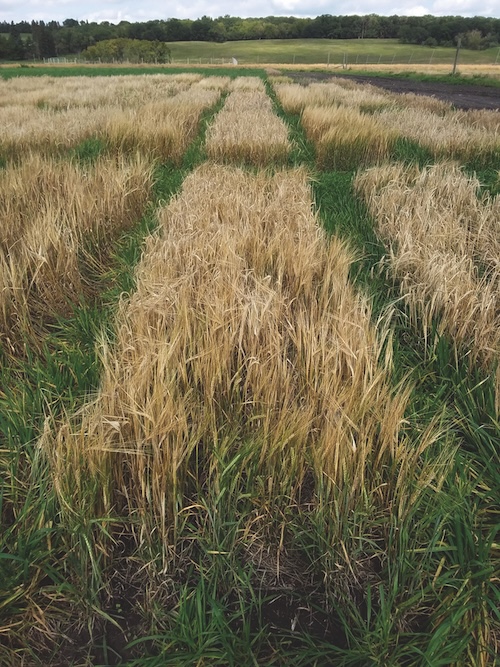
Fusarium head blight (FHB) is one of the most serious diseases of barley, mainly because of the toxins – especially deoxynivalenol (DON) – that can be produced by the fungus. That is why James Tucker, a research scientist with Agriculture and Agri-Food Canada (AAFC) in Brandon, Man., assesses thousands of barley lines each year for FHB resistance. As part of this work, he led a recently completed study that offered an intriguing opportunity to look back in order to move forward on improving FHB resistance.
This study evaluated a set of European heritage barley varieties to identify promising parents for crosses to enhance resistance to FHB and minimize DON accumulation in our modern Canadian malting barley varieties.
FHB-resistant varieties are a priority for malting barley breeders, growers and processors. “DON is toxic to all animals including humans. So, it is highly monitored, and there are very strict limitations set by the malting industry both domestically and internationally,” says Tucker.
He notes that the stringent limits for Fusarium and DON in barley grain are based on food safety requirements. However, abiding by those limits is also very important for the grain to perform well during malting and brewing.
In terms of malting, which involves soaking, germinating and kilning (heating) the grain, FHB can have several implications. “For instance, if the seed is compromised with the fungus, it can lose germination vigour. And when maltsters germinate the barley, they put the grain into an environment that can also encourage growth of the fungus and toxin production,” he says.
Another issue is that Fusarium fungi can secrete proteins called hydrophobins, which can be a cause of beer gushing. He explains that gushing is the sudden, excessive foaming of beer when a beer container is first opened.
The FHB challenge and heritage varieties
“The biggest challenge with developing resistance to Fusarium head blight and DON in barley is that the resistance is not based on major genes. It is quantitative resistance [which can come from many minor genes that each contribute a little to a plant’s overall ability to fight the pathogen]. That makes breeding quite difficult versus breeding to incorporate a single major gene,” says Tucker.
Plus, evaluating the quantitative resistance levels in breeding materials is not simple. That is partly because of a complex continuum of responses to the Fusarium pathogen, with different genes involved in the resistance in different plants. He notes: “Generally, you need larger plant populations to find the resistant lines that may have an accumulation of minor genes contributing to the final resistance level.” In addition, the grain samples have to be assessed for DON levels, involving specialized testing.
Another challenge is that many of the FHB resistance sources currently used by barley breeders have poor agronomic and malting quality traits. That’s because the resistance comes from ‘exotic barleys’ – wild or less adapted barleys. Exotic barleys can have a high degree of genetic variance which may include a few helpful traits. That’s why researchers like Tucker do a lot of work screening exotic germplasm from genebanks to seek out useful traits such as resistance to FHB.
However, crosses with exotic lines can bring a jumble of undesirable traits along with the helpful genes. This problem is known as linkage drag. Time-consuming backcrossing and repeated selection are needed to remove the unwanted traits from the progeny. And sometimes this process can also result in removal of a few of the FHB resistance genes that came from the exotic parent.
“The European heritage varieties in our study are old, including some that pre-date 1900, some possibly up to 200 years old. They have had some genetic improvements for agronomics and for some level of malting quality,” says Tucker. “So, they have some of the genetic variance removed, but not as much as today’s malting varieties.” He adds that FHB has a much longer history in Europe than in Canada. So, some of these old European varieties might have been originally selected partly because of some resistance to FHB and DON.
Tucker notes: “These heritage varieties come from a time when people were trying to understand what we could grow in Canada. People brought some of these varieties from Europe to see if they could grow them on the Prairies.” That’s why some of the heritage varieties in the study have some adaptation to our growing conditions, and some were used for crosses in early Canadian barley breeding programs.
Since then, some of the FHB resistance genes from those heritage varieties may have been lost as Canadian breeders selected for better yields and quality under our growing conditions. “Fusarium head blight wasn’t necessarily a huge economic problem on the Prairies back then,” says Tucker, “and only became a major concern during the mid 1990s after several epidemics. So, in the past, our varieties may have been selected for other traits in absence of the pathogen.”
The very strict malting quality parameters in Canada nowadays have led to further narrowing of the genetic diversity in malting barley varieties. Tucker also explains that modern malting barley breeding tends to follow an ideotype approach. An ideotype is an idealized form of the plant with certain shape, size and physiological characteristics that result in higher yielding, higher quality crops in a particular environment. “People know what makes a good malting variety for growing in our region so there is a selection pressure pushing lines towards that kind of barley,” he notes.
“Also, because of the ideotype breeding, once an elite backbone for a breeding program is established, then people will add to that. A breeder might take an elite line with Canadian malting quality and make additional crosses on that. So, there can be a very narrow path to the genetic variance in a new variety.”
About the project
“In our study, we explored some heritage barley varieties to see if they carry some resistance alleles [gene variants] not present in the current Canadian barley breeding programs,” says Tucker.
The study team included AAFC researchers at Charlottetown, Ottawa and Brandon. In 2017, Aaron Mills, an agronomist, and Dan MacEachern, a biologist, led the initial screening of 80 two-row and six-row European spring barley heritage varieties in an irrigated FHB nursery at AAFC-Charlottetown’s Harrington Research Farm in PEI.
That initial work allowed the team to identify 38 heritage varieties with reasonable levels of FHB resistance and relatively low DON levels. Those 38 varieties were sent to AAFC-Brandon for more detailed evaluations from 2018 to 2022.
At the Brandon FHB nursery, Tucker and his research group rated the FHB resistance levels in the heritage varieties and in some modern Canadian barley varieties included as checks. He also worked with Ana Badea, the AAFC-Brandon barley breeder, to grow the heritage barleys and modern checks in plots for agronomic evaluation and malt quality analysis. Barbara Blackwell, a mycotoxicologist at AAFC-Ottawa, led the DON testing on the grain.
Tapping into our history
For Tucker, this study was a unique opportunity. “Much of the work that I do is in cooperation with Canadian barley breeders. They send seeds to me for disease ratings, and I may not know exactly the background on the crosses. In a year, I grow 14,400 lines at Brandon, so I’m looking at thousands of lines. A lot of our modern Canadian malting barleys tend to look very similar, even though they have different malting profiles and disease resistance characteristics and other important differences. So, there is some diversity, but not the kind of diversity we see in the heritage varieties,” he explains.
“Beyond the fact that these heritage varieties have really interesting names like ‘Long Eared Nottingham’, they look so different compared to our modern malting varieties. People say variation is the spice of life and seeing some of these lines and how odd they look is exciting. For instance, some of them are pigmented, some are extremely short or extremely tall and they have longer heads with spaces between the seeds, whereas, today we have a more compact-style head.”
“And then there is the connection to our history in Canada, of how we grew these European lines initially because we didn’t have any adapted barleys to grow. Maybe my great grandfather was drinking beer made out of them. And some of the genes from these lines have come down the pipelines of breeders to end up in some of our modern varieties. It is really interesting to see lines that were the foundation of our modern varieties but fast-forwarding from a hundred years ago.”
Key findings
“We found that a lot of these older varieties from Europe do have lower FHB levels and lower DON compared with some of our modern varieties. And we identified lines with a high level of resistance that should be useful to barley breeders for making crosses,” Tucker says.
“We also identified lines that maybe weren’t the most resistant of all germplasm sources but they have better resistance than the modern varieties as well as reasonable agronomics and reasonable malting quality in contrast to exotics.” So, crosses with these lines could add FHB resistance genes with less linkage drag.
He emphasizes: “When a breeder makes a cross, it is a huge investment – the progeny of that cross are carried through the breeding program for years. But a lot of the lines from crosses with exotics never make it to the variety development stage. So, it is a pretty big achievement to find resistance sources that are more useful to breeders.”
Tucker is hopeful that the study will have practical benefits in the fight against FHB. As producers know, disease-resistant crop varieties reduce the need for fungicide applications, which lowers input costs for growers, minimizes pollutants in the environment and improves the sustainability of agriculture. FHB resistance also has added importance for food safety and for malting and brewing processes.
“I have made suggestions about possible crosses to Ana Badea. She is initiating crosses with some of these heritage varieties, and then she will look at the progenies. Hopefully, we can identify some lines out of that that can progress through the breeding program,” he says. “That is the ultimate goal of this study – the applied value that the research brings back to the farmers.”
Tucker also notes that some of the heritage crosses might end up in genetic studies to further investigate FHB resistance genetics. “Given the nature of FHB resistance in barley, breeders have potentially hundreds of gene targets to chase. But we can identify quantitative trait loci [locations on the barley genome associated with FHB resistance and low DON] that could be capitalized on. We may not find a silver bullet molecular marker for FHB resistance, but the more we know about the genetics, the more we can improve our strategies for incorporating the resistance.”
Funding for this study came from research grants to Tucker, Badea and Mills through the Barley Council of Canada’s National Barley Cluster, which ran from 2018 to 2023, under the Government of Canada’s AgriScience Program of the Canadian Agricultural Partnership, a government-industry partnership.