Fall-applied nitrogen (N) fertilizer can potentially increase the risk of N losses before spring seeding. Although N losses and N2O emissions are known to occur at spring thaw on the Canadian Prairies, questions remain about potential losses throughout the non-growing season. Research, funded by the Canola Agronomic Research Program (CARP), is underway to better understand the biological processes of N loss in the non-growing season, which will help producers to minimize losses, reduce costs and optimize their nutrient stewardship potential.
“Fall-applied N fertilizer remains a common practice on the Canadian Prairies and a number of research studies have demonstrated that N2O emissions during spring thaw are greater from soils that received fall-applied nitrogen fertilizer compared to soils that did not,” says Reynald Lemke, research scientist with Agriculture and Agri-Food Canada (AAFC) in Saskatoon, Sask. “The assumption has been that on the Prairies, soils freeze fairly deeply and that there is little microbial activity until soils start to thaw. Therefore, applying N fertilizer in the fall as late as possible when soils are between 5 and 10 C should reduce the risk of emissions.”
“However, research in eastern Canada showed that under deep snow cover conditions, the soils don’t freeze very hard, some microbial N transformations continue through the winter and N2O losses can be substantial.”
Another project led by Rich Farrell used a flux tower to measure winter N2O emissions on the Prairies, with the results showing ongoing low levels of emissions throughout the non-growing season.”
In 2022, Lemke initiated a three-year project on non-growing season N losses under semi-arid conditions, including microbial dynamics and the potential of an enhanced-efficiency fertilizer to help reduce emissions.
The project compared N2O emissions from soils with and without fall-applied fertilizer N during the entire non-growing season period. The objectives were to determine the factors driving the timing and magnitude of microbial dynamics and soil-emitted N2O during this period.
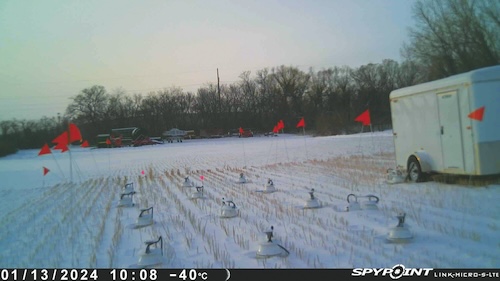
They deployed a system of automated gas chambers at the AAFC Saskatoon Research Farm that allowed for quasi continuous measures of emissions throughout a 24-hour period. The three N treatments included a control with zero N, urea alone and urea with a dual inhibitor. The banding treatments were made as close to freeze-up as possible on all plots. The automated systems were set up to start measuring at time of fall fertilizer application until seeding the next spring.
Additional measures included soil core sampling through the winter and regular soil temperature readings. Plant root simulators were installed to monitor N transformations which, along with the chamber system measuring CO2 emissions, provided an indication of microbial activity.
Soil samples were shared with University of Saskatchewan collaborator, Bobbi Helgason, who used molecular biology tools (qPCR) to enumerate key N cycling genes for soil N2O production and consumption. The objectives were to determine the abundance of genes from microbial populations associated with N metabolism pathways, such as N2O reductase genes and other genes associated with microbial nitrification and denitrification. The microbial populations and associated genes were compared over the time, including differences between the three N treatments.
Winter conditions and snow
Winter conditions varied considerably during the project, with the first winter experiencing a significant snowstorm almost immediately after fall fertilizer applications, setting up for snow cover on the plots throughout the winter and into the spring thaw timing. The soil temperatures hovered not lower than –5 C down to 20 cm depth throughout that time period, showing the insulating effectiveness of the snow.
However, in the second winter the plots had little to no snow cover after the fall fertilizer applications in the fall of 2023 until mid-January, where snow cover remained low. Although air temperatures remained warm, the soil temperatures dropped to –10 C down to 20 cm depth under lower snow conditions.
“We suspect that the differences in snow cover is a partial explanation of the differences we measured in magnitude and pattern of CO2 and N2O emissions over the two non-growing seasons,” explains Lemke. “In the first year, the CO2 and N2O emissions were higher than the second year, but continuous emissions were measured over both years. Continuous CO2 emissions also implies continuous biological activity during that time period, however, the pattern and relative timing of emissions was different between the two years. CO2 emissions dropped during the January/February period in the second year under the colder soil temperatures.”
“In terms of timing of emissions,” adds Lemke, “in year one, about 40 to 50 per cent of CO2 and N2O emissions were measured during the winter and the other half at spring thaw. In the second year, a higher proportion of emissions were measured at spring thaw than during the winter.”
Evaluating additional results
The results also showed an influence of the N fertilizer treatments, with the highest emissions from urea plots, the lowest from control plots and the urea with the dual inhibitor treatments midway in between. The two N product treatments were both significantly higher than the control, but responded differently. Nitrate availability in the spring was significantly higher with urea alone as compared to urea and dual inhibitor treatment, while both were higher than the control. The urea and dual inhibitor treatment did slow down and inhibit N transformations, reducing losses during nitrification or denitrification. Although it is difficult to determine exactly when and where the emissions are occurring, the results do indicate the inhibitor is having an impact on emissions.
“Generally, the microbial data indicated that there were sizable active N cycling populations through the overwinter time period,” adds Lemke. “The experiments provided an indication of which types of N cycling microorganisms and what genes are present, but not necessarily the level of activity. The results showed that in the first year, the populations tended to increase after the fertilizer treatments including the control treatment that did not receive any N, which suggests this may be a result of the soil disturbance from the banding operation rather than the application of the fertilizer product. The soil temperatures did seem to have an impact on microbial activity. The measure of continuous CO2 emissions also supports the presence of microbial activity.”
“Although we did not measure actual total N losses, there is a high likelihood that the N2O measured, especially during spring thaw, were from denitrification,” says Lemke. “This would indicate losses of N2, which are generally 10 to 30 times or higher compared to the N2O emissions measured. Therefore, growers who plan to include fall-applied N in their operations need to understand the risk of N losses, where they are occurring and the timing of those losses. The recommendation of timing fall-applied N to be made as close to freeze-up as possible still holds, even though it won’t eliminate the risk completely.”
Overall, the research shows there are ongoing N transformations throughout the winter period prior to spring thaw, even when N is applied very close to freeze-up in the fall. Recognizing that although there are reasons to consider fall-applied N, this practice does create a higher risk of N loss both agronomically and environmentally. Implementing best practices, including the 4Rs of fertilizer stewardship to reduce N2O emissions, also means saving costs through greater nitrogen retention for crop use.