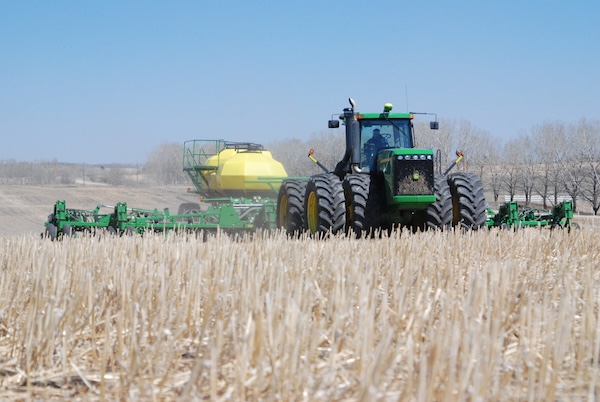
After the disastrous 2021 drought, the researchers at Saskatchewan’s Agriculture Applied Research Management (Agri-ARM) centres came up with a research demonstration program exploring how to mitigate risk when applying nitrogen (N) fertilizer in dry years. As a risk management tool, they looked into applying a portion of N requirements in a side – or midrow-band – at seeding followed up with a post-emergent N application.
“There are some situations in Western Canada where we might consider a split application. For example, we had two years of drought back to back, and our soil moisture reserves were depleted. So, a producer might say, ‘Well, I’m going to hold back on some of that nitrogen, and if conditions improve, then I’ll apply some more nitrogen after the crop has emerged,’” says Mike Hall, research coordinator with the East Central Research Foundation and Suncrest College at Yorkton, Sask.
In the early 2000s, research by AAFC research scientist Guy Lafond compared applying all N requirements at seeding to a split application of either 50 or 67 per cent at seeding followed by an in-crop UAN (28-0-0) application. In wheat, applying 67 per cent of fertilizer N at seeding plus 33 per cent in-crop yielded the same as applying all the N at seeding. For canola, applying 50 per cent of N at seeding with the remaining in-crop produced similar yield as applying all of the N at seeding. In canola, application should be made before the six-leaf stage to maximize yield.
Building on this earlier research, demonstration trials supported by the Sustainable Canadian Agricultural Partnership (Sustainable CAP) were conducted in 2022 at the Agri-ARM sites at Yorkton, Indian Head, Melfort, Outlook, Scott and Swift Current. The Outlook site was under irrigation to provide a best-case scenario where moisture wasn’t limited.
There were a total of 13 treatments. These rates include soil residual N in the top 24 inches of soil plus applied fertilizer N. Nitrogen applied at seeding was banded or side-banded, and post-emergent applications of N were dribble banded UAN mixed with Agrotain to reduce the risk of volatilization loss.
Hall says that assuming a good yield potential of 60 bu./ac., a wheat crop requires 162 lb. N/ac. So, an 80 lb./ac. would represent approximately 50 per cent of total N requirement and 110 lb./ac. would be approximately 67 per cent of the total N requirement. The first five treatments set up a response curve to increasing rates of nitrogen as side-banded urea at seeding to establish the maximum yield response.
Results varied by site
The response to N rate and placement timing varied by site, with Indian Head and Outlook having high response to N. Swift Current and Scott were low yielding and fairly unresponsive to N due to drought. Yorkton was high yielding but unresponsive to N because of high soil N reserves and loss of 20 to 30 per cent of yield due to hail. Melfort also had high soil N reserves and response to N was low.
At Indian Head, residual soil N was 16 lb. N/ac. and yields plateaued at 91 bu./ac. at the 140 lb. N rate. Grain protein increased linearly with the highest protein content of 15.5 per cent at 170 lb. N, which was 0.9 per cent higher than the content at the 140 lb. N rate.
There were some yield and protein differences with the split applications at Indian Head compared to the 140 lb. N banded at seeding. Top-dressing 60 lb. N as UAN at the 3- to 5-leaf stage over top the 80 lb. N base rate resulted in a yield of 87.7 bu./ac., statistically lower than the 91 bu./ac. when all 140 lb. N was banded at seeding. However, protein content was 15.2 per cent with the split application compared to 14.6 per cent with the 140 lb. N at seeding.
Dribble banding 30 lb. N/ac. on top of the higher base rate of 110 lb. N significantly reduced grain protein and numerically increased yield a little compared to dribble banding 60 lb. N on a base rate of 80 lb. N, but yield was still lower than the 140 lb. N at seeding treatment.
“The Indian Head site was very responsive to N in terms of yield and grain protein. Split applications of N tended to be a little lower yielding compared to placing all the N down at seeding. While most of the yield and grain protein potential could be reclaimed with a split application, the economics of this approach were poorer at the 140 lb. level of fertility and only slightly better at 170 lb. rate,” says Hall.
Hall’s economic analysis used a price of $10.56/bu., a 12.5 per cent protein, a protein premium of $0.66/per cent/bu., and a cost of $1.33/ lb. N and a $10/ac. UAN application cost. At the 140 lb./ac. level of N fertility, none of the split applications at the 3- to 5-leaf generated as much income as putting all the N down in the sideband at seeding, says Hall. “This was true whether we started with a base rate of 80 or 110 lb. N/ac. in the side band.”
The treatment with 140 lb. N at seeding returned $190/ac. compared to Treatment 2, while the 80 lb. + 60 split at three to five-leaf returned $175, and the 110 lb. + 30 lb. split returned $149. Delaying UAN application to the flag-leaf reduced economic returns even further. “If you’re going to take that strategy, you really should be getting that nitrogen out there before the three- to five-leaf stage,” says Hall.
At the irrigated Outlook site, yields maxed at 140 lb. N/ac. at approximately 75.6 bu./ac. when all the N was banded at seeding, but was statistically similar to the 110 lb. N treatment (74.6 bu.). Protein continued to climb with rates up to 170 lb. N/ac. ending at 13.6 per cent.
There was a significant yield increase when UAN was split applied at the three- to five-leaf stage with the 80 + 60 treatment yielding 85.6 bu. and the 110 + 30 split treatment yielding 83.3 bu. Similar to Indian Head, split applications at the flag-leaf stage resulted in a yield loss compared to the three- to five-leaf stage.
The split applications also provided higher economic returns than applying all the N at seeding at Outlook. The 140 lb. N treatment at seeding returned $113/ac. compared to Treatment 2, while the 80 + 60 split at the three- to five-leaf stage returned $203, and the 110 + 30 returned $157. Delaying split application to the flag-leaf stage resulted in lower economic returns relative to the three- to five-leaf stage, and the 140 lb. N banded treatment.
“Split application of N is common practice in moist environments such as England because it improves nitrogen use efficiency. Perhaps something similar was happening under irrigation in Saskatchewan,” says Hall. “This requires further study to determine if these results can be replicated.”
Low response at drier sites
Response at Swift Current was low due to drought. Yields ranged from a low of 33.1 bu./ac. for the check soil N treatment of 59 lb. N/ac. and up to 35.7 bu./ac. for the 170 lb. N treatment. Few of the split N treatments yielded more than the 80 lb. N base treatment (33.6 bu.) but by less than 2 bu./ac. Relative to the base treatment of 80 lb. N/ac., all treatments lost money due to drought, with the higher N rates losing the most.
Results at Scott were similar to Swift Current, with yields in the 43.6 to 48.9 bu./ac. range. Again, a few of the split applications had marginally higher yields, but by less than 1 bu./ac. All split applications were also less economical than the base rate of 80 or 110 lb. N. “During the drought at Swift Current and Scott, holding back on side-banded N at seeding would have proved economical because producers would not have bothered with dribble banding any additional N,” says Hall.
Overall, Hall says that split application could be beneficial under irrigation when an early UAN application could improve yield and profitability. However, Hall would like to see more research supporting this strategy for irrigation. Under dryland, if conditions are very dry, and the long-term forecast doesn’t look promising, holding backing on N at seeding could provide some economic benefit. He cautions, though, that a grower shouldn’t hold back too much, suggesting no more than 30 lb. N/ac.
“The economic risk of holding back on a lot of N at seeding and missing the opportunity to dribble band N early if conditions improve are much larger than losses incurred from over fertilizing the crop by 30 lb. N/ac.,” says Hall. “Perhaps the best approach with split applications on dry land farming is to not do it on purpose. Fertilize for a regular crop yield and if conditions look exceptional consider dribble-banding UAN in-crop at the three- to five-leaf stage.”