Rollie Vincent, President of Rolland Vincent Associates, made his annual pilgrimage to the Canadian Business Aviation Association conference held in July this year in Richmond, B.C., to provide an update on the state of the global business aviation aircraft market. More than 500 people registered for the event held at Million Air’s facility at the Vancouver International Airport. Vincent largely bases his findings and forecasts on a global quarterly survey of aviation leaders that has generated approximately 28,000 responses from 143 countries since 2011. These survey data points are often given context through traditional economic sources and shared through JetNet iQ reports.
Vincent began his 2025 CBAA presentation with a slide highlighting seven takeaways, starting with a “stabilized” $53 billion order backlog for the Big Five aircraft manufacturers – Bombardier, Dassault Falcon, Embraer, Gulfstream and Textron Aviation. He also noted a 36 per cent increase in pre-owned jet retail transactions in first quarter of 2025, when compared with the year ago quarter, possibly driven by buyers trying to get ahead of tariffs.
Vincent also points to a stable book-to-bills ratio of 1.02, which is determined by dividing orders by deliveries. He forecasts 820 new business jet total deliveries for 2025, which would be up eight per cent year over year. Vincent also points to a drop in business optimism since the election of U.S. President Donald Trump, because of tariff uncertainty, and persistent factors limiting aircraft production – supply chain, labour experience and slow certifications.
The United States continues to dominate the global business aircraft fleet accounting for more than 24,000 total aircraft, according to Vincent’s statistics, including 15,833 jets and 8,207 turboprops. Brazil placed second in terms of total fleet numbers with more than 2,600 aircraft (1,155 jets and 1,478 turboprops), Mexico is third with more than 1,550 aircraft (1,051 jets and 518 turboprops), Canada is fourth with more than 1,400 aircraft (596 jets and 811 turboprops), and Germany is fifth with more than 750 aircraft (471 jets and 286 turboprops).
From JetNet numbers, and excluding the U.S., Canada at 811 is second in turboprop fleets, following Brazil at 1,478 and ahead of Australia (498), Germany (286), South Africa (242) and France (223). Combining JetNet report figures with economic numbers from The Economist (May 2025) and International Monetary Fund (April 2025), four of the top five fleet countries are forecasted to have flat GDP growth in 2025, with Brazil as an outlier with a projected 1.9 per cent GDP growth rate. “Canada, Mexico and the United States are now expected to be in a shallow recession for the full year,” Vincent says. “When we see economic slowdowns in key markets like this, where 70 per cent of the business aircraft are operated, that has an impact.”
Looking at the Big Five OEM order backlogs (with the Q1 2025 backlog for Dassault Falcon being estimated), the overall number decreased by just one per cent year over year moving from $53.8 billion in 2024 to $53 billion in the first quarter of 2025. The order backlogs had been increasing dramatically since 2021, following a sharp decline in 2020 (at $27.3 billion for the Big Five) of negative 18 per cent year over year. The order backlog then increased 42 per cent to $38.8 billion in 2021, followed by a by 27 per cent jump to $49.1 billion in 2022, by three per cent to $50.4 billion in 2023, and then by seven per cent to $53.8 billion in 2024.
“We are sitting at a good place and some of the OEMs have really kicked it up. If you look at 2020, we kind of bottomed out at around $27 billion of backlog with the Big Five,” Vincent says. “Now, we’re up over 50 and it’s been a steady climb, with Embraer and Textron in particular… but all of the OEMs are sitting under a couple of years of backlog. This is a really good news story.”
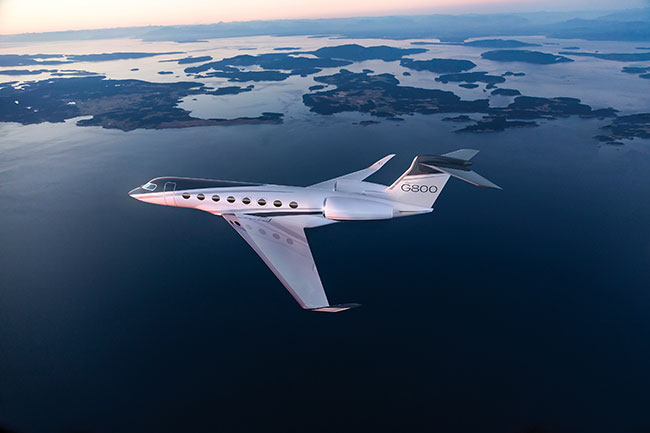
Among the Big Five OEMs, Brazil-based Embraer’s order backlog increased the most in 2024 and 2025, rising 72 per cent from 2023 at $4.3 billion to $7.4 billion in 2024, with 2025 numbers expected to be around $7.6 billion. In 2025, forecast backlogs from largest to smallest include: Gulfstream at $18.2 billion, Bombardier at $14.2 billion, Textron Aviation at $7.9 billion, Embraer at $7.6 billion and Dassault Falcon at $5.2 billion. Gulfstream took over the OEM backlog lead coming out of the pandemic after Bombardier sat in the top spot from 2014 to 2019. The first pandemic year backlog saw Gulfstream hit $11.3 billion with Bombardier at $10.7 billion. Now both aircraft makers are coming out with new ultra-long-haul jets in the Gulfstream G800 and the Bombardier 8000.
In terms of book-to-bills, four of the Big Five OEMS are hovering around 1.0 in 2025 with Embraer again being a standout, reaching over 2.0 in 2024 and also back in 2021. “Embraer is still outperforming… it’s quite impressive,” Vincent says, using the words “pretty strong” to describe the industry’s overall book-to-bills position. “A book to bill with one is a stable market. That means production is matching order demand.
“We have to remember, conversion of backlog to cash is really difficult,” Vincent adds. “We have a lot of airplanes being built right now, and [the OEMs] will deliver our forecast [of 820 new jets delivered] by year’s end, but tariff uncertainties are really the order of the day.”
Vincent then addressed the 36 per cent increase in year over year sales of pre-owned aircraft. “Pre-owned aircraft transactions outpace new transactions by about four to one. There’s no backlog. It’s instantaneous. If something happens, it’s a signal of the market,” Vincent explains. “We came just flying out of Covid and inventory for sale was evacuated from our industry. Meaning, if you wanted to buy a used car, there were no used cars in the lot, especially good ones. And that’s currently the state again.”
In terms of current market condition sentiment, based on a 2025 second quarter survey, with 298 responses to date, the majority of participants, 53.7 per cent, described themselves as pessimists when asked: How would you describe the current market conditions for business aviation. This group of respondents also believes the market has not hit its low point, which is how 14.2 per cent of respondents described their market sentiment. Optimists, those respondents who feel the sector is past the low point, came in at 32.1 per cent.
JetNet’s 2025 second quarter survey also asked if the uncertainty about the impact of tariffs would delay purchase plans for a new aircraft within the next 12 months. By excluding the response of Uncertain, which accounted for 15 per cent of 294 respondents, the category of Somewhat Agree saw the largest response at 33.3 per cent, followed by Strongly Agree at 25.6 per cent, Somewhat Disagree at 19.9 per cent and Strongly Disagree at 17.4 per cent.