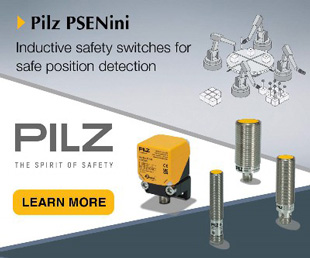
Pilz PSENini - Inductive safety switches for safe position detection.
When designing safety-related applications, engineers refer to ISO 14119:2025 to select the appropriate interlocking device for the application. This standard defines five types of interlock devices, categorized by mechanical vs. non-contact technology, and further divided into coded and non-coded actuators.
ISO 14119: 2025 - Table 2 - Overview of interlocking devices
Type
Actuation Principles
Actuator Coding
Guard Monitoring
Detection / Actuation Principle
Typical Examples
ISO 14119 Annex
Type 1
Mechanical
Uncoded
Direct
Physical contact (positive opening)
Rotary cam switch Linear cam switch Hinge switch
A.1 A.2–A.4
Type 2
Coded
Physical contact with coded key
Tongue (trapped key) Hinged tongue switch
A.3 B.1
Type 3
Non-contact
Uncoded
Magnetic Inductive Capacitive Ultrasonic
Magnetically actuated switch Inductive safety sensor Any suitable object as target
C.1
Type 4
Coded
Magnetic RFID Optical
Coded magnetic switch RFID safety switch Optically coded switch
D.1–D.2
Type 5
Mechanical (Trapped key)
Coded
Indirect or Direct
Mechanically shaped key / lock system
Trapped-key interlock systems Key-exchange systems
Annex E
Type 3 interlock devices (Non contact, uncoded) are often overlooked in safety applications, despite offering distinct advantages in specific use cases.
The PSENini inductive safety switches are a good example of a Type 3 solution. These non-contact sensors provide safe position detection without requiring an actuator, making them ideal for applications where traditional mechanical or coded interlocks are impractical or not feasible.
PSENini sensors use solid-state technology with OSSD outputs, ensuring reliable performance regardless of the number of actuations over the lifetime of the application. Because they have no dead zone, installation is straightforward and flexible. The sensors are available with standard M12 quick‑connect connectors, simplifying installation and maintenance.
Contact your local Pilz representative to select the right interlocking device for your application.